That sharp, stabbing heel pain that greets you with your first steps out of bed is unmistakable. If you’re tired of dreading that morning walk to the coffee pot, we’re here to tell you there’s a better way. At Pure Motion Chiropractic, we help our patients in Chicago find natural, effective relief for plantar fasciitis, starting with simple, targeted actions to calm inflammation and restore flexibility. This is about building trust by clearly explaining your condition and creating a supportive path to recovery.
Your First Steps Toward Natural Plantar Fasciitis Relief
Waking up to that intense, knife-like pain in your heel is the hallmark of plantar fasciitis. It happens because the plantar fascia—that thick, fibrous band on the bottom of your foot—tightens up overnight while you sleep. Those first few steps force that cold, shortened tissue to stretch suddenly, and the result can be excruciating.
But you don’t have to live with that dreaded morning ritual. The real goal isn’t just to survive those first few minutes, but to get to the root of the problem: the inflammation and chronic tightness that have taken hold. By being proactive, you can start managing your pain effectively and get back to moving freely. For our patients here in Roscoe Village and across Chicago, our team at Pure Motion Chiropractic is all about creating a clear, supportive path to recovery from conditions like back pain, neck pain, and chronic discomfort.
Easing the Morning Pain
The most immediate challenge is always that jarring morning pain. This isn’t just an annoyance; it’s a clear signal from your body that the fascia is under major stress. The good news is you can head this off before you even plant your feet on the floor.
A few gentle, pre-emptive moves can completely change your morning experience by:
- Gently lengthening the fascia: This prevents that sudden, painful stretch that happens the second you put weight on your foot.
- Boosting blood flow: Warming up the tissue makes it more pliable and resilient, kind of like warming up a rubber band before you stretch it.
- Providing immediate support: Shielding your foot from a hard, flat floor is your first line of defense.
We see this all the time with our patients: people jump out of bed and walk barefoot to the bathroom. That single act can strain the cold, tight fascia and set your healing back for the rest of the day.
Quick-Start Guide to Easing Morning Heel Pain
We’ve put together a simple routine to make this easy. Before your feet even touch the ground, use these three techniques to dramatically reduce morning pain and kickstart your recovery.
| Technique | How It Helps | Quick Instructions |
|---|---|---|
| Pre-Stretch Your Foot | Gently lengthens the fascia after a night of shortening, preventing the ‘first-step shock.’ | While still lying down, grab your toes and gently pull them toward your shin. Hold for 30 seconds. Repeat 3 times. |
| Ankle Pumps & Circles | Increases blood flow to the area, warming up the muscles and ligaments around the heel. | Point and flex your foot 10 times, then rotate your ankle in circles 10 times in each direction. |
| Keep Supportive Shoes by Your Bed | Avoids the shock of walking barefoot on a hard floor, which immediately strains the sensitive fascia. | Slip on supportive shoes or slippers with good arch support before standing up. |
Making these small adjustments a consistent part of your morning can have a massive impact on your pain levels and how quickly you recover. It’s all about building smarter habits that protect your feet while they heal, empowering you to finally leave that heel pain behind.
Targeted Stretching and Strengthening: Your First Line of Defense
If you’re dealing with that sharp, stabbing heel pain from plantar fasciitis, a consistent stretching routine isn’t just a suggestion—it’s the most important thing you can do for real, natural relief. But you can’t just do any old stretch. The secret lies in very specific movements that target both the plantar fascia under your foot and the tight muscles in your lower leg, which are often the hidden source of the problem.
Think of it this way: your calf muscles and your plantar fascia are connected. When your calves get tight—and this happens to almost everyone, from runners to people standing all day at work—they tug on your Achilles tendon. That constant pulling action creates a ton of tension right where the fascia attaches to your heel, sparking that all-too-familiar inflammation and pain. To truly fix the issue, we have to look at the entire system, a core principle of chiropractic care and long-term wellness.
The Right Stretches for Lasting Relief
Our goal here is twofold: gently lengthen that tight band of tissue under your foot and improve flexibility in your calf muscles. When you do this, you reduce the daily strain on the fascia, giving it the space it needs to finally heal. The best part is these exercises are simple. You can easily do them while watching TV, under your desk, or even before you swing your legs out of bed in the morning.
This is where consistency really pays off. Small, daily movements add up to significant healing over time. This little graphic breaks down the perfect morning routine to prep your feet before they hit the floor.

Warming up the fascia before it has to bear your weight is absolutely critical. It helps prevent those tiny micro-tears that cause all the pain in the first place.
The Best Evidence-Backed Movements
The proof is in the research. A landmark study showed that stretching the plantar fascia directly was far more effective than just stretching the Achilles tendon. The group stretching the fascia had a 95% success rate in pain reduction, a huge jump from the 71% seen in the Achilles-only group.
To put this into practice, we’ve put together a simple daily routine that combines the most effective movements.
Daily Plantar Fasciitis Stretching and Strengthening Routine
This simple, effective daily routine combines the most crucial stretches and exercises for plantar fasciitis relief. Perform this routine upon waking and before bed for best results.
| Exercise | Instructions | Sets & Reps | Best Time to Perform |
|---|---|---|---|
| First-Step Fascia Stretch | Before getting out of bed, cross one leg over the other. Gently pull your toes back toward your shin to feel a stretch in the arch. | Hold 30 seconds, 3 times per foot. | Morning (before standing) |
| Wall-Facing Calf Stretch | Face a wall, hands on wall. Step one foot back, keeping the leg straight and heel down. Lean forward to feel a calf stretch. | Hold 30 seconds, 3 times per leg. | Morning & Evening |
| Towel Curls | Sit in a chair, feet flat on the floor with a small towel in front. Use your toes to scrunch the towel toward you. | 10-15 repetitions per foot. | Anytime (e.g., watching TV) |
| Heel Raises | Stand with feet flat. Slowly rise onto your toes, hold for 2-3 seconds, and slowly lower back down. | 2 sets of 10-15 reps. | Anytime, after warming up |
By sticking to a simple schedule like this, you’re building a habit that directly promotes healing and prevents the pain from coming back.
One of the most common mistakes we see at our Roscoe Village practice is patients stretching too aggressively. The goal is a gentle, sustained pull, not a sharp, painful one. If it hurts, ease up.
Building a Stronger Foundation for Your Feet
While stretching is essential for relief and flexibility, strengthening is what keeps the problem from coming back. The small muscles inside your feet (the intrinsic muscles) act like a natural support system. When they’re weak, your foot mechanics suffer, and more stress gets dumped right onto the plantar fascia.
Beyond the towel curls and heel raises in the table, you can also try exercises like Marble Pickups. Just drop a handful of marbles on the floor and use only your toes to pick them up one by one and place them in a bowl. It sounds simple, but it’s fantastic for building dexterity and strength in those tiny foot muscles.
Building up your ankles is just as important. Strong ankles provide a stable base for your entire foot. For more great ideas on this, check out our guide on how to strengthen weak ankles.
By combining these specific stretches and strengthening exercises, you become an active participant in your recovery. You’re not just chasing the pain away—you’re fixing the underlying mechanical problems. This is the key to treating plantar fasciitis naturally and moving from a cycle of pain to one of strength and stability.
Your Shoes Might Be Sabotaging Your Recovery
When you’re dealing with the sharp, nagging pain of plantar fasciitis, the shoes on your feet can make or break your healing process. We’ve seen it time and time again with patients here at our Roscoe Village clinic—every single step you take either helps your foot heal or adds more strain to that already angry tissue.
Getting serious about recovery means taking a hard look at your daily footwear. It’s one of the first and most important conversations we have with our patients. Many people don’t realize that their favorite worn-out sneakers or stylishly flat shoes are actively working against them, prolonging the pain.
What to Look For in a Supportive Shoe
Finding the right shoe isn’t about chasing a specific brand. It’s about finding a few key features that create a supportive environment for your injured foot, allowing the plantar fascia to rest even while you’re on the move.
Look for these characteristics:
- Real Arch Support: This is the big one. The shoe needs a firm, built-in arch that follows the natural curve of your foot. This prevents your arch from collapsing, which is a primary cause of strain on the fascia.
- A Cushioned Midsole: Good cushioning absorbs the shock that travels through your heel with every step. You’re looking for a sole that feels supportive and forgiving, not so soft that it feels mushy.
- A Stiff Heel Counter: This is the part that cups the back of your heel. A firm heel counter is crucial for controlling foot motion and preventing it from rolling inward (overpronation), a common problem that puts incredible stress on the plantar fascia.
Our Pro’s Shoe Test: Grab a shoe and try to bend it in half. A truly supportive shoe will only flex where your foot naturally bends—at the ball of the foot. If it folds up easily in the arch, it offers practically zero support and won’t help you.
Just as important is what you avoid. Going barefoot on hard floors like tile or hardwood is one of the worst things you can do for plantar fasciitis. The same goes for flimsy flip-flops, flat sandals, and unsupportive slippers. They offer no protection and can set your recovery back for weeks.
The Great Debate: Over-the-Counter vs. Custom Orthotics
Even the best shoes sometimes aren’t enough. That’s where orthotics come in, providing an extra layer of targeted support. But it’s crucial to understand that not all orthotics are created equal.
Over-the-Counter (OTC) Inserts are the generic gel or foam insoles you find in a pharmacy. They can add a bit of cushioning and may be sufficient for very mild cases, but they are a one-size-fits-all solution for what is a very personal problem.
Custom Orthotics, on the other hand, are prescribed medical devices designed from a mold or scan of your unique feet. They go far beyond just cushioning. A true custom orthotic is engineered to correct your specific biomechanical faults—the subtle ways your foot moves and distributes weight that are contributing to your pain.

The research strongly backs this up. A 2005 evidence review found that 86% of patients achieved long-term improvement with conservative treatments that included shoe inserts and stretching. One of the studies cited showed that silicone inserts delivered a 95.2% positive response rate, which was far better than what was achieved with stretching alone. By reducing impact and properly supporting the arch, orthotics simply create a better healing environment. You can read more about these findings on AAFP.org.
Why a Professional Fitting Is So Important
A truly effective custom orthotic is born from more than just a simple footprint. At our clinic, our chiropractors perform a detailed gait analysis, which means we watch you walk to pinpoint the exact biomechanical issues that need correcting. This is part of our commitment to personalized care.
This detailed data allows us to create an orthotic that provides support exactly where your foot needs it. A generic insert from a box just can’t compete with that level of personalization.
By addressing the root cause of the strain, custom orthotics do more than just mask the pain—they help stop the problem from coming back. Investing in the right support for your feet is an investment in your mobility and a huge step toward getting back to a pain-free life. You can learn more about our process for creating custom orthotics in Chicago.
Getting Immediate Relief at Home
When that sharp, stabbing pain hits your heel, long-term healing strategies can wait. You need relief now. The good news is you have some powerful, simple tools at your disposal to calm down an angry plantar fascia and get through your day with less pain.
Think of these as your first-aid response for a flare-up. They are easy, effective, and target the inflammation and tension that are making you miserable.

Cool the Inflammation with Cold Therapy
One of the first things we tell our patients at our Roscoe Village clinic is to make ice their best friend. Cold therapy is incredibly effective for acute pain because it constricts blood vessels, which dials down the swelling and inflammation. It also provides a welcome numbing effect for fast relief.
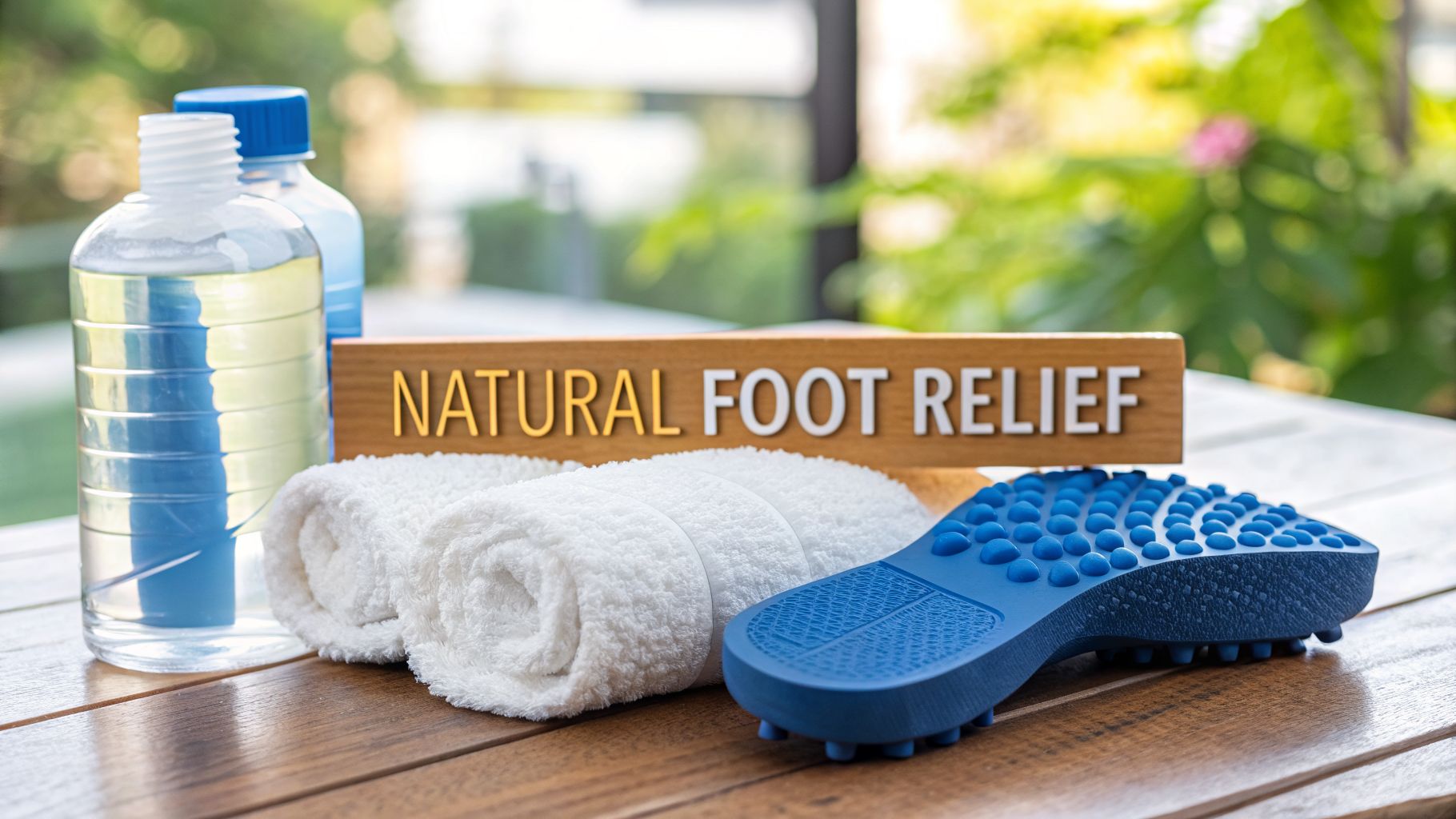
A fantastic method is the frozen water bottle roll, which combines cooling and massage into one easy step.
- How it works: Just grab a standard plastic water bottle, fill it with water, and freeze it. When your foot is aching, sit down, place the frozen bottle on the floor, and gently roll your foot over it from heel to toe.
- The right pressure: Don’t try to be a hero and press down hard. The goal is a gentle massage; let the cold do most of the work.
- Timing is everything: Roll for 10-15 minutes at a time. This is the sweet spot for reducing inflammation without irritating your skin. Feel free to do this a few times a day, especially after you’ve been on your feet for a while.
Work Out the Knots with Self-Massage
Inflammation is only part of the story. A lot of your pain comes from the plantar fascia itself—and the muscles connected to it, like your calf—becoming incredibly tight and developing knots, or trigger points. Self-massage is your way of manually breaking up that tension and encouraging the tissue to relax.
You don’t need fancy equipment, just a few common household items:
- Your own hands: Use your thumbs to press deeply into the arch of your foot. When you find a sore spot, hold that pressure for about 30 seconds. You should feel it start to release.
- A tennis ball: This is a perfect starting point. Its softer surface is more forgiving, which is great when your foot is extremely tender.
- A lacrosse ball: When you’re ready for deeper work, a firm lacrosse ball can apply more precise pressure to get at those really stubborn knots.
As you’re rolling, if you find a point that’s especially tender, just pause and hold the pressure there for a moment. This is a simple trigger point release that can provide a surprising amount of relief. To understand more about the science behind this, take a look at our guide on what is trigger point therapy.
Expert Tip: Don’t forget your calf! A tight calf muscle constantly pulls on your heel bone, putting stress right where the plantar fascia attaches. Spend a few minutes using your hands or a foam roller to massage your lower leg; it makes a huge difference.
Stop Morning Pain with a Night Splint
Is the worst part of your day that excruciating pain with your first few steps out of bed? There’s a reason for that. Overnight, your foot naturally relaxes into a pointed position, allowing the plantar fascia to shorten and tighten for hours. A night splint is designed to stop this cycle.
It simply holds your foot in a gentle, slightly flexed position while you sleep. This keeps a light, consistent stretch on both the plantar fascia and the Achilles tendon, preventing them from seizing up. The result? You wake up, stand up, and walk with dramatically less pain.
And this isn’t just anecdotal. One study of people with chronic plantar fasciitis found that 88% of those who used a night splint reported significant improvement, with their pain levels dropping by an average of 59%. Another trial showed that patients using splints were considered “cured” in an average of just 12.5 weeks—much faster than those without. It’s a small adjustment to your nightly routine that can completely change your mornings.
It might feel a bit strange for the first few nights, but sticking with it is one of the best things you can do for your recovery. You can read the full research on splint efficacy to see just how effective they can be.
When to See a Chiropractor Near Me in Chicago
It’s incredibly frustrating when you’re doing everything right at home—stretching, icing, even buying new, supportive shoes—and that sharp heel pain just sticks around. If you’re still dreading that first step out of bed, it doesn’t mean you’ve failed. It simply means the root of the problem likely runs deeper than what home care alone can fix, and it’s time to find a trusted “chiropractor near me” in Chicago.
Home treatments are a fantastic first line of defense, but sometimes, underlying mechanical problems in your feet, ankles, or even your hips are the real culprits. Trying to push through the pain without addressing these core issues can unfortunately turn a temporary problem into a chronic one.
Telltale Signs You Need Professional Help
Knowing when to escalate your care is key to a faster recovery. If any of these sound familiar, it’s a good time to get an expert opinion.
- Pain That Gets Worse: Your pain shouldn’t be intensifying or spreading if your home treatments are working. This is a major red flag.
- No Improvement After Several Weeks: If you’ve been consistent with your routine for 3-4 weeks and see little to no relief, you need a different approach.
- Inability to Walk Normally: Limping or changing your stride isn’t just a sign of pain; it’s a recipe for creating new problems in your knees, hips, and back.
- Numbness or Tingling: Any sensation of pins and needles or numbness could point to nerve involvement and needs to be evaluated right away.
For our neighbors here in Roscoe Village and across Chicago, this is exactly where we come in. Think of us not as a last resort, but as your partner in getting this sorted out quickly and correctly.
A common misconception is that you must exhaust all home options before seeing a professional. In reality, early intervention with a sports chiropractor often prevents weeks or months of unnecessary pain and helps correct the root cause before it becomes a chronic issue.
How Our Local Chicago Chiropractor Accelerates Healing
At Pure Motion Chiropractic, our chiropractors look at your body as a whole. That nagging foot pain is rarely just a foot problem. More often than not, it’s a symptom of a breakdown somewhere along your body’s kinetic chain—the interconnected system of joints and muscles from your spine down to your toes. Our personalized treatment plans address the root cause of your pain.
During your initial consultation, we explain what chiropractic care is and how it fits into your broader wellness goals. Then, we outline your personalized care plan, which may integrate several therapies:
- Chiropractic Adjustments: We look beyond your foot. Subtle misalignments in the ankle, knee, hip, or lower back can throw off your entire gait, placing a massive amount of repetitive strain on the plantar fascia. We use gentle, precise spinal adjustments to restore proper joint movement and take that constant pressure off your foot.
- Therapeutic Massage & Soft Tissue Work: Chronic plantar fasciitis often involves incredibly tight calf muscles, a stiff Achilles tendon, and knots (adhesions) within the fascia itself. We use specific hands-on techniques to break up this tension, improve circulation, and give the tissue the flexibility it desperately needs to heal.
- Personalized Physical Therapy & Posture Correction: Are you sure you’re doing the right stretches, or doing them correctly? We provide one-on-one coaching to make sure your exercises are effective and safe. We’ll build a routine to strengthen the small, supporting muscles in your feet and lower legs, creating a stronger and more resilient foundation.
By combining these therapies, we address your body as the interconnected system it is. When we correct your overall mechanics and release that deep-seated tension, we create the perfect environment for your plantar fascia to finally heal for good, improving your mobility, posture, and quality of life.
Our New Patient Special is a great, low-commitment way for Chicago residents to get a thorough evaluation and a clear plan forward. You don’t have to live with this pain.
Your Plantar Fasciitis Questions, Answered
Even with a solid game plan, it’s natural to have questions as you work through healing your plantar fasciitis. To give you some clarity, we’ve put together answers to the most common questions we hear from patients at our Roscoe Village clinic.
How Long Does Natural Healing for Plantar Fasciitis Take?
This is the big one, and the honest answer is: it depends. The two biggest factors are the severity of your condition and, most importantly, your consistency with treatment.
For many people who stick to their daily routine of stretching, icing, and wearing the right footwear, you can expect to feel a real difference within 4 to 6 weeks. But if you’ve been dealing with this pain for a while, it can be a more stubborn fight. Chronic cases can easily take several months to fully resolve. The key is consistency—those small, daily efforts really do compound over time.
Can I Keep Exercising with Plantar Fasciitis?
Absolutely, but you have to be smart about it. The last thing you want to do is pound your already-inflamed feet with high-impact activities like running or jumping. That’s a surefire way to set yourself back.
The trick is to swap those out for low-impact workouts. Some fantastic options include:
- Swimming or water aerobics: The water’s buoyancy takes all the pressure off your feet, letting you get a great workout without the pain.
- Cycling: Whether you’re on a stationary bike or hitting the road, this is an excellent cardio choice.
- Elliptical machines: These give you a running-like motion but without the jarring impact on your heels.
No matter what you choose, always stretch your calves and feet before and after. And listen to your body! If you feel that familiar heel pain, it’s a clear signal to stop and pick a different activity.
Should I Use Heat or Ice for the Pain?
We get this question all the time, and there’s a simple rule to follow. When the pain is sharp and your foot feels swollen or inflamed—especially after a long day or a workout—ice is your best friend. Cold therapy helps constrict the blood vessels to reduce swelling and gives you that welcome numbing effect for immediate relief.
Heat, on the other hand, is best used before activity. Applying a warm pack for a few minutes in the morning can help increase blood flow, making the fascia a little more pliable and ready for your morning stretches. Just be careful not to apply heat when it’s already inflamed, as that can make things worse.
Our go-to advice for patients is simple: Ice for pain, gentle heat for stiffness.
When Is It Time to See a Chiropractor for Heel Pain?
If you’ve been diligently following a home treatment plan for a few weeks and the pain just isn’t budging—or if it’s so bad it’s getting in the way of your daily life—it’s time to call a professional. Pain that lingers is a sign that there are probably underlying biomechanical issues that stretches and ice alone can’t fix.
A chiropractor at Pure Motion Chiropractic will look at your entire kinetic chain, from your feet all the way up your spine. Often, the problem isn’t just in the foot. Misalignments in the ankle, knee, or even your hips can put extra strain on the plantar fascia. By identifying and addressing those root causes, we can build a plan for real, long-lasting relief.
Don’t let heel pain run your life. If you’re tired of temporary fixes and ready to get to the root of the problem, our team at Pure Motion Chiropractic is here to help our Chicago neighbors. Schedule your appointment online today and take the first real step toward moving without pain.