If you've ever had a stubborn, painful 'knot' in a muscle that just won't seem to go away, you've already met a trigger point. For many of our neighbors in Chicago, these knots are the hidden source of everything from nagging headaches to persistent back pain. In simple terms, trigger point therapy is a specialized treatment designed to locate and release these tight, irritable spots in your muscles, helping to finally silence the pain signals they send out.
At Pure Motion Chiropractic, we see firsthand how these trigger points can disrupt daily life. Our goal is to provide a clear path to relief, starting with a clear understanding of what’s really causing your discomfort.
Understanding Trigger Point Therapy
Think of a small, tangled snag in a rope—that's a pretty good picture of what a trigger point is like inside your muscle. It's a tiny, hyper-irritable spot where a patch of muscle fibers has gotten stuck in a contracted state, like a miniature cramp that won't let go. This knot doesn't just hurt right where it is; it can also send pain signals to completely different parts of your body. This is a phenomenon known as referred pain.
This is precisely why a tender spot in your shoulder might be the real culprit behind your recurring headaches, or why a deep knot in your gluteal muscle could be sending pain down your leg, mimicking sciatica. As your local chiropractor, we specialize in tracking down these hidden pain sources for our patients across the Roscoe Village community, helping you finally understand where your discomfort is really coming from.
This diagram helps visualize how the therapy works—from identifying the contracted knot to applying pressure that encourages release and restores comfort.

As you can see, the main goal is to deactivate that "knot," which stops the pain signals and allows the muscle to function normally again.
To help you get a quick handle on these ideas, here’s a simple breakdown of the core concepts of trigger point therapy.
| Trigger Point Therapy at a Glance |
| :— | :— |
| Concept | Simple Explanation |
| The Trigger Point | The actual "knot" or tender nodule in the muscle. |
| The Taut Band | The tight, rope-like band of muscle where the knot is found. |
| Referred Pain | Pain felt in a different area than the trigger point's location. |
| Local Twitch Response | An involuntary muscle twitch when the trigger point is pressed correctly. |
| Ischemic Compression | The technique of applying sustained pressure to release the knot. |
Understanding these basics makes it clear how this targeted therapy can provide such effective relief for our patients.
Key Concepts Explained
To really grasp how this works, let's unpack the foundational ideas. These concepts are at the heart of the care we provide to our Roscoe Village community every day, ensuring we address the root cause of your pain.
- The Trigger Point: This is the palpable nodule or "knot" you can feel within a tight band of muscle. It’s not only tender to the touch but can also restrict your range of motion and cause muscle weakness.
- The Taut Band: You can't have a trigger point without this. It's the larger, rope-like band of tense muscle fibers that the trigger point lives in. It’s what your practitioner is feeling for during an exam.
- The Local Twitch Response: When the right amount of pressure is applied to an active trigger point, it can cause the muscle to jump or twitch involuntarily. While it might sound strange, this is actually a great sign—it confirms we've found the exact spot.
Trigger point therapy is much more than a deep-tissue massage; it's a precise clinical technique. The goal is to apply specific, sustained pressure to the knot, encouraging it to "let go." This process helps restore healthy blood flow, flushes out metabolic waste, and allows the muscle fibers to return to their normal, relaxed length.
By zeroing in on these specific points, we can effectively treat a wide range of conditions that often don't respond to general stretching or a standard massage. It’s a fundamental part of a complete chiropractic care plan aimed at delivering lasting relief, not just a temporary fix.
The Science Behind Your Muscle Knots
Ever wonder what’s actually going on with that stubborn, painful knot in your shoulder that just won’t go away? The feeling is unmistakable, but the reason it exists lies deep within your muscle fibers and how they react to stress from daily life, whether from an auto injury, sports, or poor posture.
When a muscle is overused, injured, or simply stuck in a bad position for too long (like sitting at a desk all day), its fibers can get trapped in a miniature crisis.

Think of it as a tiny energy shortage at a microscopic level. The affected muscle fibers are screaming for the oxygen and nutrients they need to relax, but they can't get them. This ongoing contraction clamps down on blood flow, trapping metabolic waste like lactic acid.
The result? A sensitive, painful little nodule we call a trigger point. This vicious cycle of strain, oxygen deprivation, and waste buildup is what creates that all-too-familiar deep, nagging ache.
Active vs. Latent Trigger Points
Not all trigger points are created equal. At our Roscoe Village clinic, we find it helpful to explain the two main types, as it clarifies what you're feeling and why.
- Active Trigger Points: These are the attention-seekers. They're the ones causing your current, noticeable pain without you even having to touch them. An active trigger point is tender when pressed and famously refers pain to other, seemingly unrelated areas. That tension headache throbbing at your temples? It could easily be an active trigger point in your neck muscles.
- Latent Trigger Points: These are the silent troublemakers. They're "sleeping" knots that don't cause pain while you're at rest, but they're far from innocent. Latent trigger points can quietly restrict your movement, cause muscle weakness, and contribute to a general feeling of stiffness. They only wake up and hurt when you press directly on them.
A classic example we see every day is what’s been dubbed "tech neck." Hours spent hunched over a laptop are the perfect recipe for creating both active and latent trigger points in the neck and upper back, leading to constant stiffness and recurring headaches. The same goes for anyone with a physically demanding job or recovering from a sports or auto injury.
Knowing the difference is key to creating a treatment plan that actually works. Releasing an active trigger point can bring the immediate pain relief you're looking for, while addressing the sneaky latent ones can restore your full mobility and prevent future problems.
This is especially true for complex areas like the hips. In fact, releasing trigger points in the surrounding muscles is a huge part of the puzzle, which you can learn more about in our guide on how to improve hip mobility.
The History of Modern Trigger Point Therapy
When you choose a treatment, you want to know it’s built on a solid foundation. Trigger point therapy isn't a new fad; it’s a well-established practice with roots stretching back decades, born from careful observation and a drive to understand the real source of pain.
The story begins with a remarkable physician who completely changed how we think about muscle pain. Her work laid the scientific groundwork for the kind of effective, hands-on therapies we use at Pure Motion Chiropractic today to help our community live with less pain.
The Pioneer of Trigger Point Mapping
Our modern understanding of trigger point therapy really traces back to the 1940s and the incredible work of Dr. Janet Travell. As an American physician and researcher, she poured her career into studying chronic muscle and skeletal pain. It was Dr. Travell who first documented the idea of myofascial trigger points and, more importantly, their predictable patterns of referred pain.
She spent years creating detailed "maps" that showed how a specific knot in one muscle could consistently cause pain in a completely different part of the body. Before her research, these connections were a mystery, often leading to frustrating misdiagnoses and treatments that never got to the root of the problem.
Dr. Travell’s work proved that where you feel the pain isn't always where the problem is. A tense muscle in your shoulder could be the real source of your recurring headaches. A knot deep in your hip might be the culprit behind your nagging knee pain. This was a massive leap forward in pain management.
Her discoveries finally gave clinicians a logical, repeatable way to trace pain back to its true origin.
From a President's Back Pain to Modern Chiropractic Care
Dr. Travell's work gained such respect that it eventually landed her in the White House. While she first published the term ‘myofascial trigger point’ back in 1942, her expertise truly hit the mainstream when she became the first female personal physician to a U.S. President. She was tasked with treating President John F. Kennedy's severe, chronic back pain using her trigger point techniques.
Her success in managing his debilitating pain brought incredible legitimacy and widespread attention to her methods. You can learn more about the historical development of these treatments and see just how significant her contributions were.
This history shows that the principles behind what we do have been tested and refined for over 80 years. The techniques we use today are a direct evolution of that foundational work, combining Dr. Travell’s pain-mapping genius with the latest advancements in manual therapy. When you come to our Chicago clinic for trigger point therapy, you’re benefiting from a rich history of clinical evidence and a deep understanding of the human body.
What to Expect During Your Treatment Session
Walking into a new kind of therapy appointment can feel a little uncertain, especially if you're nervous about chiropractic care. Knowing what to expect can make all the difference. Let’s pull back the curtain on what a trigger point therapy session at Pure Motion Chiropractic actually looks like. It’s a hands-on, focused process designed to find the real source of your pain and bring you relief.

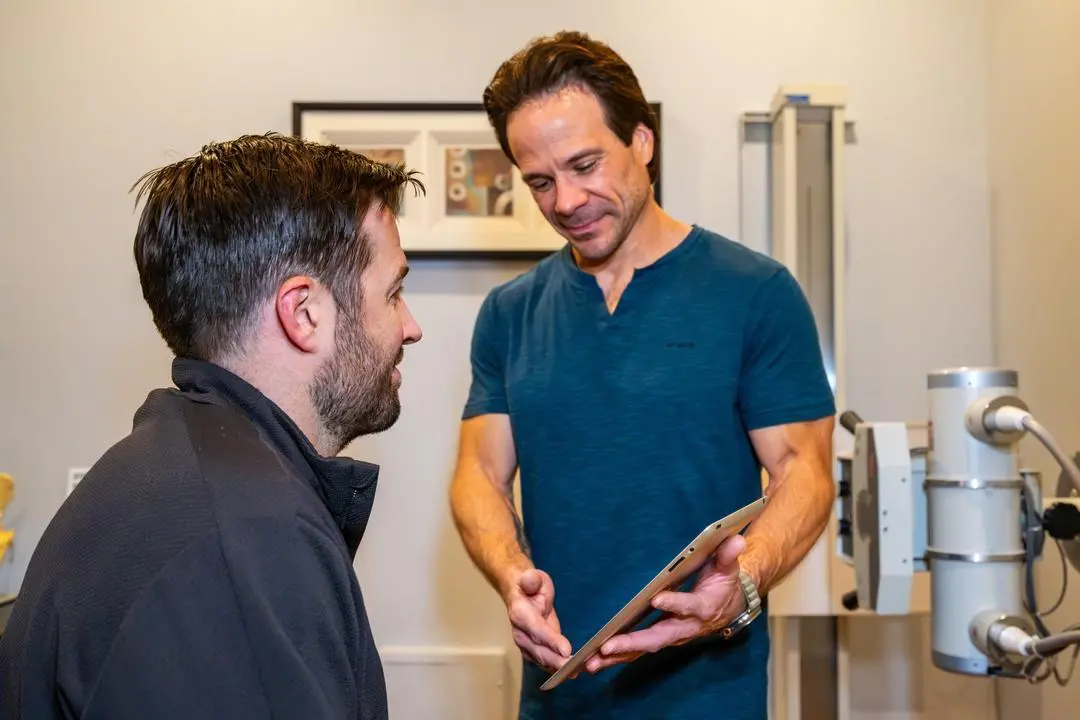
Your visit always starts with a conversation. Dr. Karl will listen to what you've been experiencing and then use skilled palpation—a gentle but diagnostic touch—to explore the muscles and pinpoint the exact trigger points causing you trouble. This step is crucial; it’s how we ensure the treatment is targeted right where it needs to be.
The Treatment Process Unpacked
Once we've zeroed in on the problem spots, the hands-on work begins. The main technique we use is called ischemic compression. This sounds technical, but it’s really quite simple: we apply steady, direct pressure to the muscle knot and hold it, usually for anywhere between 20 to 60 seconds.
It’s important to be honest about how this feels. Many patients describe it as a "good hurt"—a strong, focused sensation that lets you know we’re on the right spot. It’s that feeling of, "Yep, that's it!" This is a sign that we're effectively targeting the source of your pain.
That intense pressure is followed by a feeling of deep release as the knot finally lets go. We are in constant communication with you, always working within your comfort level to make sure the pressure is productive without being overwhelming. It's a much more specific approach than a general massage. To get a better sense of the differences, you can learn more about our deep tissue massage services.
A Complete and Integrated Approach
Trigger point therapy is incredibly effective, but it rarely works in isolation. To get the best, most lasting results, we build it into a complete care plan that addresses the whole picture. Our goal is to offer a comprehensive wellness solution.
Here’s what a typical integrated session might look like:
- Assessment: We start by identifying the active trigger points that are creating your pain patterns.
- Trigger Point Release: Dr. Karl applies ischemic compression to deactivate those knots and quiet the referred pain.
- Chiropractic Adjustment: We often follow up with a spinal or joint adjustment to restore proper alignment and nerve function. This helps correct the underlying stress that allowed the trigger points to form in the first place.
- Targeted Stretching: Finally, we'll guide you through specific stretches designed to lengthen the newly released muscle fibers and reinforce your newfound flexibility.
This multi-faceted approach ensures we’re not just chasing symptoms. We are deactivating the immediate source of pain, correcting the structural issues that created it, and giving you the tools to maintain your progress and prevent the problem from returning.
From Trigger Points to Neuromuscular Therapy
Dr. Travell’s groundbreaking work didn't just stop with her findings. Her research on trigger points was a massive leap forward, inspiring other forward-thinking practitioners to build on her foundation and ask, "What comes next?"
This is where the concept of trigger point therapy starts to evolve into a more systematic, comprehensive approach known as Neuromuscular Therapy (NMT). This evolution was critical. It bridged the gap between just understanding a single "knot" and treating the complex relationship between our muscles and our nervous system.
NMT takes the core idea of a trigger point and places it within a much bigger picture. It acknowledges that these knots are often just the symptom of a larger problem, like nerve compression, chronic postural imbalances, or dysfunctional movement patterns. This big-picture perspective is central to how we approach care here at Pure Motion Chiropractic.
A Chiropractic Connection
Interestingly, the development of NMT has deep roots in both medical and chiropractic science. The structured form of neuromuscular therapy started taking shape in Europe back in the 1930s, eventually making its way to the United States.
A key figure in its American development was Dr. Raymond Nimmo, a U.S. chiropractor. He discovered that Dr. Travell's trigger point research lined up perfectly with what he was already seeing in his own clinic with soft tissue. His work was instrumental in establishing NMT as a cornerstone of conservative care, especially in practices like ours. You can dig deeper into the history of neuromuscular therapy and its chiropractic pioneers.
This connection is so important because it highlights that trigger point release isn't just about rubbing a sore muscle until it feels better. It’s about figuring out why that muscle is so angry in the first place.
By weaving in the principles of NMT, we look at the entire kinetic chain. We don't just ask, "Where does it hurt?" We ask, "What is the nervous system doing to create and maintain this pattern?" This allows us to provide more meaningful, lasting relief for our patients here in Roscoe Village and the surrounding Chicago neighborhoods.
Our approach combines the targeted release of specific trigger points with a deep understanding of how your muscles and nerves are communicating. This ensures your treatment is not only precise but also gets to the root cause of your discomfort.
We also know that releasing the tension is only half the battle. To make sure the relief sticks, we almost always incorporate therapeutic exercises to reinforce the positive changes we make during your session. This helps your body learn new, healthier patterns, turning temporary relief into a long-term solution so you can move and feel better for good.
Your Partner in Pain Relief in Chicago
Taking that first step toward a pain-free life can feel like a huge hurdle, but you don’t have to figure it all out alone. If there’s one thing to take away from this guide, it’s this: you have options. Simply understanding what trigger point therapy is and how it gets to the root cause of your pain is the first real move toward finding relief that actually lasts.
At Pure Motion Chiropractic, we want to be your dedicated partner on this journey. We combine targeted trigger point therapy with our deep expertise in chiropractic care to build a plan that makes sense for your body and your life. We’ve seen it time and again—releasing those stubborn, deep-seated muscle knots can dramatically reduce pain, restore your full range of motion, and get you back to doing what you love.
A Patient-Centered Approach in Your Neighborhood
Conveniently located in Roscoe Village, we're proud to serve our neighbors in Lakeview, North Center, Logan Square, and the surrounding Chicago communities. We know life is hectic, which is why we've designed our entire practice to be as easy and stress-free as possible.
From easy street parking to flexible early morning and late evening appointments, we’ve handled the details so you can focus on your health. Our patient-centered approach means we actually listen. We want to hear your story, understand your goals, and build a personalized plan that fits into your life.
We believe that effective care is built on trust and a clear understanding of your condition. Our commitment is to empower you with the knowledge and treatment needed to not just manage your pain, but to resolve it for good.
If you’re tired of letting chronic pain call the shots, it’s time to do something about it. Stop guessing what might be causing your discomfort and start getting real answers.
Schedule your consultation with Dr. Karl at Pure Motion Chiropractic today. Let’s work together to create a personalized plan that helps you finally move better, feel better, and live a life with less pain.
Your Questions About Trigger Point Therapy, Answered
If you're new to trigger point therapy, it's natural to have questions. Here are some clear, straightforward answers to the things we hear most often from patients at our Chicago clinic.
Does Trigger Point Therapy Hurt?
This is easily the most common question we get, and the answer isn't a simple yes or no. When we apply direct pressure to a trigger point, you'll feel a very specific, notable discomfort—a sensation many people describe as a “good pain.” That feeling is how we know we’ve found the exact source of the problem.
This pressure is always kept within your tolerance and is only held for a few moments at a time. Afterward, you might feel a little sore, but it's usually mild and fades quickly. What replaces it is far better: a deep sense of relief, less tension, and a whole new freedom of movement.
How Many Sessions Will I Need?
That really depends on your unique situation. We have to consider how severe your condition is and, just as importantly, how long you've been dealing with the pain. It's not uncommon for patients to feel a significant difference after just one or two visits to our Roscoe Village clinic.
However, for issues that are more chronic or complex, it will likely take a series of treatments to unwind the muscle patterns and achieve a lasting fix. Dr. Karl will lay out a clear, personalized care plan for you during your initial consultation, so you'll know exactly what to expect.
Is This Different From a Regular Massage?
Yes, it's worlds apart. While a general massage is wonderful for overall relaxation and easing broad muscle tension, trigger point therapy is a precise clinical treatment. Think of it less like a spa day and more like a focused mission to solve a specific problem.
Instead of the long, flowing strokes of a massage, we use targeted, sustained pressure on those stubborn muscle knots. The goal is very specific: to deactivate them, shut down their referred pain signals, and get the muscle working properly again. This focused approach is what delivers such powerful, lasting relief from persistent pain.
Ready to get to the real source of your pain? The team at Pure Motion Chiropractic is here to help you move better and feel better. Schedule your appointment online or give us a call today.