That sharp, throbbing ache along your shinbone can stop any runner in their tracks. The moment you feel it, the single best thing you can do is stop the high-impact activity causing the pain. Your first 48 hours are all about damage control, and jumping on it with the RICE method—Rest, Ice, Compression, and Elevation—can kickstart the healing process and manage that initial wave of inflammation. Here at Pure Motion Chiropractic, we understand how frustrating injuries can be, and we're here to help our Roscoe Village community get back on their feet with confidence.
Your First Steps For Immediate Shin Splint Relief
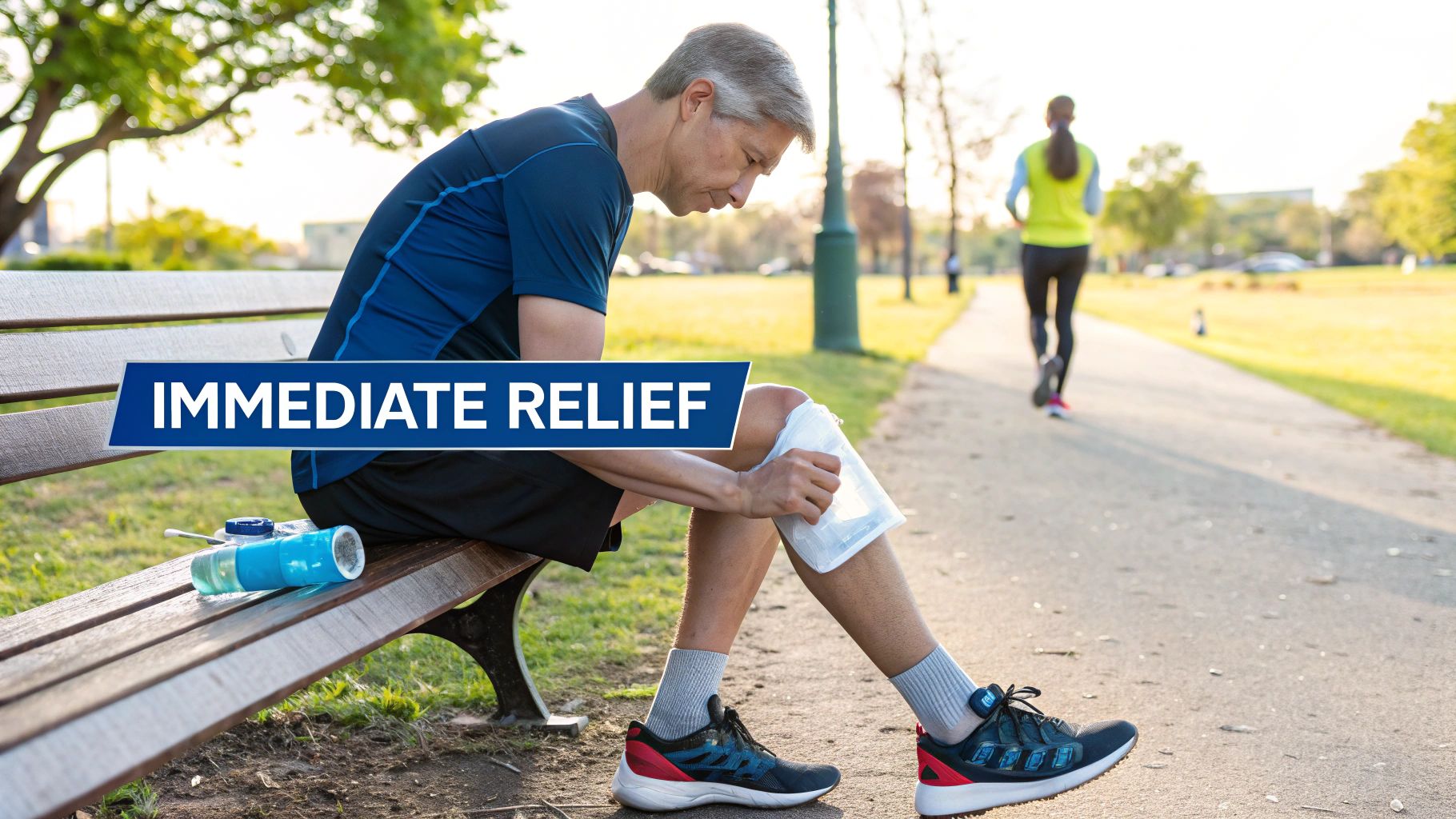
When you first feel that telltale shin pain, your next moves are critical. Trying to "run through it" is a classic mistake we see all the time, and it’s a fast track to turning a minor annoyance into a chronic problem that could even lead to a stress fracture. We want to help you avoid that.
Taking the right steps immediately can drastically cut down your recovery time. The most effective first response is the RICE method, a time-tested protocol for any acute soft tissue injury. It’s simple, effective, and gives your body the break it needs to start healing.
Here’s a quick, straightforward breakdown to get you started.
Immediate First Aid Using The RICE Method
| Method | Action | Duration & Frequency |
|---|---|---|
| Rest | Stop all high-impact activities (running, jumping). | 2-4 weeks of active rest is often recommended for the acute phase. |
| Ice | Apply an ice pack wrapped in a thin towel to the painful area. | 15-20 minutes every 2-3 hours for the first 48 hours. |
| Compression | Use an elastic compression bandage, wrapping from below the pain and moving up. | Wear during the day to help control swelling. |
| Elevation | Prop your leg up above the level of your heart whenever possible. | As often as you can, especially when resting or icing. |
This simple protocol is your first line of defense against worsening inflammation and pain.
What “Active Rest” Really Means
Rest is non-negotiable, but it doesn’t mean you’re sentenced to the couch for weeks. The idea is to avoid aggravating the muscles and tissues along the shinbone while still maintaining your cardiovascular fitness. We know how important it is for our local athletes to stay active.
Think of it as a smart swap. Ditch your runs on the hard pavement of Chicago’s streets for low-impact cross-training. Activities like swimming at a local pool or hitting the elliptical are fantastic options—they keep you moving without the repetitive, jarring stress that caused the problem in the first place.
Proper Icing And Compression Techniques
For these methods to work, you have to be consistent. Icing for 15-20 minutes every 2-3 hours during those first 48 hours is the gold standard. Just be sure to never put the ice pack directly on your skin; always use a thin towel to prevent ice burn.
When you use a compression wrap, start below the painful spot and work your way up. It needs to be snug enough to give support, but not so tight that it’s cutting off your circulation. If you feel any numbness, tingling, or more pain, it’s definitely too tight.
While this initial home care is crucial, professional guidance is what really gets to the root of the problem. Here at Pure Motion Chiropractic in Roscoe Village, we have over a 90% success rate treating shin splints with a combination of manual therapy and specific exercises—a huge leap beyond basic home remedies. Treatment has evolved way past just telling people to rest. To learn more about modern, effective approaches, check out this great resource on motionspecificrelease.com.
Finding the Root Cause of Your Shin Pain
To get rid of shin splints for good, you have to play detective and figure out why they started in the first place. That nagging, persistent ache along your shin isn't random—it's your body's alarm system screaming that something is out of balance.
The official term is Medial Tibial Stress Syndrome (MTSS). It sounds complex, but all it really means is that the muscles in your lower leg are yanking on your shinbone (the tibia) so hard and so often that the attachment point has become inflamed and angry.
Imagine a bunch of ropes pulling on a stake in the ground. If you suddenly start yanking on those ropes harder, faster, or at a weird angle, the ground around the stake will start to give way. That’s what’s happening in your leg, and our job at Pure Motion Chiropractic is to figure out which "rope" is causing the problem.
The Usual Suspects: Common Shin Splint Triggers
The culprit is almost always some form of repetitive stress that your body simply wasn't ready to handle. It's rarely just one thing, but a perfect storm of a few common factors.
- Doing Too Much, Too Soon: This is the classic mistake. You feel a burst of motivation and suddenly jump from running five miles a week to fifteen. Your muscles, bones, and tendons haven't had the time to adapt to that new load.
- Pounding the Pavement: Constantly running on hard surfaces like Chicago’s concrete sidewalks puts way more shock through your lower legs than a softer track, trail, or treadmill. That impact adds up with every single step.
- Worn-Out or Wrong Shoes: Your shoes are your body's shock absorbers. Running in old, flattened-out sneakers is a recipe for disaster because your shins are forced to take the brunt of every footstrike.
Shin splint pain is a direct signal of overuse. The tissue connecting muscle to your shin bone is inflamed, and identifying your specific trigger—whether it’s new shoes or a new training plan—is the key to finding real relief.
Deeper Biomechanical Glitches
Sometimes, the issue isn't just what you're doing, but how your body is built to do it. These underlying mechanical issues can make you far more likely to develop shin splints, even with a smart training plan.
A huge one we see all the time in our Roscoe Village clinic is overpronation, which is when your foot rolls too far inward after it hits the ground. This forces the tibialis posterior muscle—a key stabilizer for your arch and ankle—to work overtime to control the movement, which directly yanks on the inside of your shin.
People with flat feet are especially prone to this. Without a strong, supportive arch, the foot collapses inward, and the whole kinetic chain gets thrown off balance.
Think back to when your pain started. Did it pop up right after you bought those new minimalist running shoes? Or maybe a week after you added hill sprints to your Tuesday workout? Connecting the dots between your activities and your body's signals is the first step toward building a recovery plan that not only heals the current pain but stops it from ever coming back.
Building A Stronger Foundation To Prevent Recurrence
Once that sharp, nagging pain starts to quiet down, the real work begins. It’s tempting to think you’re in the clear, but this is the critical moment to shift your focus from first aid to long-term prevention. This is how you build resilient lower legs that can actually handle what you ask of them.
Ignoring this phase is exactly why so many runners and athletes get stuck in a frustrating cycle of shin splints coming back again and again. True prevention means tackling the underlying weaknesses and imbalances that caused the pain in the first place.
Essential Strengthening Exercises
Think of your lower legs as a complex support system. Shin splints are often a sign that some of the muscles in that system aren't pulling their weight, forcing others to take on too much strain. The goal here is to wake up those slacker muscles, particularly the ones that support your arch and control how your foot hits the ground.
A few foundational exercises can make a world of difference:
- Calf Raises: Find a step and stand on the edge. Slowly lower your heels until you feel a good stretch, then press all the way up onto the balls of your feet. The key is slow, controlled movement. Aim for 3 sets of 15-20 reps.
- Towel Curls: This one is simple but powerful. Sit in a chair, place a small towel on the floor, and use only your toes to scrunch it toward you. This directly targets the small, intrinsic foot muscles that are crucial for arch support.
- Heel Walks: It might feel a little silly, but it works. Just walk around for 30-60 seconds at a time on your heels, keeping your toes pulled up toward your shins. This is fantastic for strengthening the tibialis anterior muscle—the main muscle running along the front of your shin.
Getting these movements right is the first step in building stability from the ground up. As this image shows, shin splints rarely have a single cause; they're the result of multiple stressors piling up.
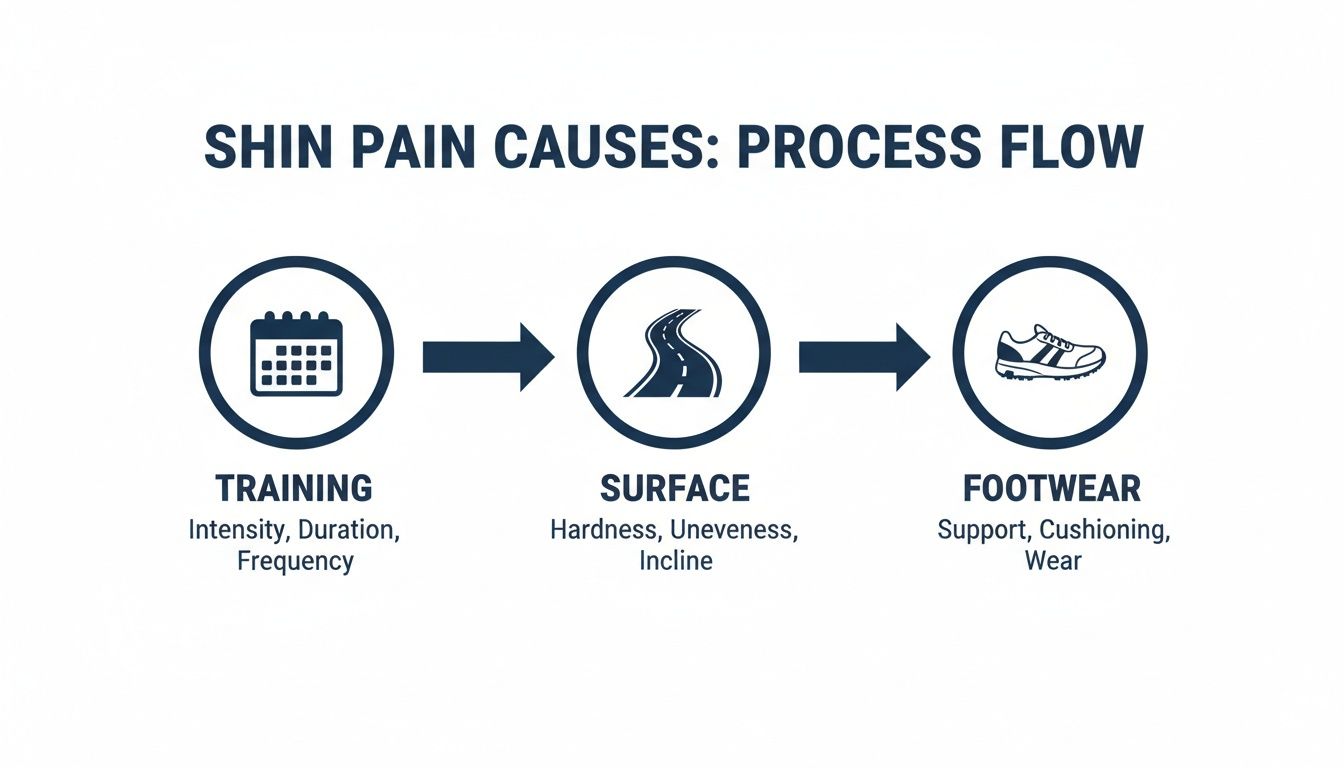
This is why a comprehensive approach that strengthens weak links is so important.
The Importance Of Flexibility
Chronically tight calf muscles are a classic villain in the shin splint story. When your calves are locked up, they restrict your ankle's range of motion and can cause your foot to roll inward excessively (overpronation), which puts a ton of rotational stress right on your shinbone.
Because of this, consistent, targeted stretching is non-negotiable.
A proactive approach that combines both strengthening and stretching is the most effective way to manage your recovery. This empowers you with the tools to prevent shin splints from sidelining you again.
Make sure you’re doing these two stretches after every workout or run:
- Straight-Leg Calf Stretch (Gastrocnemius): Stand facing a wall and place your hands on it for support. Step one leg back, keeping it perfectly straight with your heel planted firmly on the floor. Lean forward until you feel the stretch in your upper calf. Hold for 30 seconds.
- Bent-Knee Calf Stretch (Soleus): From the same position, bring your back foot in a bit and bend that knee, keeping your heel on the floor. You'll feel this stretch lower down in your calf. Hold for another 30 seconds. Repeat both stretches 3 times on each leg.
From there, we can introduce a more structured progression to safely build back your strength and resilience.
Here is a basic framework we often use to guide patients as they return to activity. This table provides a clear roadmap for what to focus on and when, ensuring you don't do too much, too soon.
Shin Splint Rehabilitation Exercise Progression
| Phase | Goal | Example Exercises |
|---|---|---|
| Phase 1: Activation & Stability | Re-establish neuromuscular control and activate deep stabilizing muscles without stressing the tibia. | Towel Curls, Heel Walks, Glute Bridges, Clamshells |
| Phase 2: Strength Building | Begin loading the muscles of the lower leg and hips to build a solid foundation. | Calf Raises (double leg), Resistance Band Ankle Movements, Bodyweight Squats |
| Phase 3: Functional & Dynamic | Introduce movements that mimic your sport to prepare the body for impact and dynamic stress. | Single-Leg Calf Raises, Box Jumps (low), Walking Lunges, Skipping |
This progression helps ensure you’re building on a solid foundation, gradually preparing your body to handle the demands of your sport without re-injury.
Consistency is everything. Making these exercises and stretches a non-negotiable part of your routine is the best investment you can make in your running future. At Pure Motion Chiropractic, we don't just hand you a sheet of exercises; we guide you through routines tailored to your specific biomechanics. You can learn more about how we integrate therapeutic exercises into our plans to help patients in Roscoe Village build a stronger, more bulletproof foundation.
Choosing the Right Gear and Professional Support
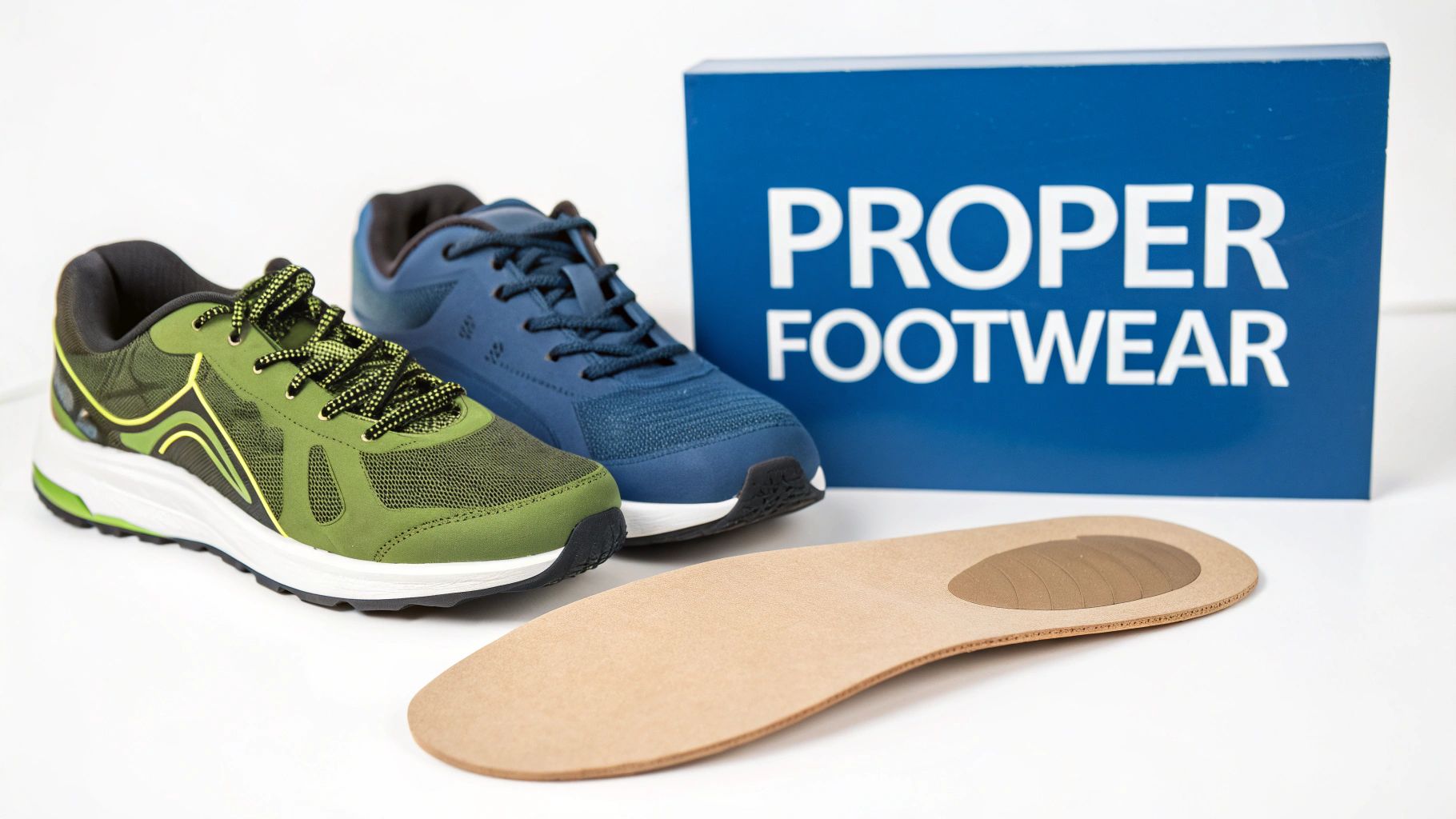
While the exercises we've covered build up your body's resilience, the gear you use can either help you heal or completely sabotage your efforts. Your running shoes are your first line of defense against impact, and wearing the wrong pair is like driving a car with bald tires—they simply can't protect your lower legs from the repetitive stress of pounding the pavement.
A common mistake we see runners make is thinking that more cushioning is always the answer. The truth is a lot more nuanced. The right shoe has to match your specific foot mechanics. This is where you'll hear terms like stability and neutral cushioning thrown around, and they're incredibly important.
Finding the Right Footwear for Your Feet
The goal isn't to force your foot into a certain position, but to find a shoe that supports your natural motion without overcorrecting it. Shoes generally fall into a few key categories designed for different types of runners.
- Neutral Shoes: These are a great fit for runners with a normal pronation pattern. That means your foot rolls inward just the right amount to absorb shock effectively on its own.
- Stability Shoes: These are built for runners who overpronate, where the foot rolls inward too much. They typically have features like firmer foam (called a medial post) on the inner side of the shoe to gently guide the foot back toward a more neutral alignment.
- Motion Control Shoes: Offering the highest level of support, these are usually recommended for runners with severe overpronation or very flat feet.
Getting a professional gait analysis at a specialty running store here in Chicago can be a game-changer. They'll actually watch you run on a treadmill and analyze your foot strike to recommend a shoe category that works with your body, not against it.
When Custom Orthotics Are the Answer
Sometimes, even the most technologically advanced running shoe isn't enough to correct significant biomechanical imbalances. If you have flat feet, high arches, or persistent overpronation, your tibialis posterior muscle is probably working overtime with every single step. This is a direct cause of shin splints for many people in our community.
This is where custom foot orthotics can make a profound difference. Unlike a generic insole you grab off the shelf, a custom orthotic is molded precisely to the unique contours of your feet.
Custom orthotics act as a stable base, promoting neutral alignment from the ground up. By supporting the arch and cradling the heel, they prevent inefficient movement and significantly reduce the strain on the muscles and tendons that attach to your shinbone.
At Pure Motion Chiropractic, we perform a detailed biomechanical assessment to figure out if custom orthotics are the right solution for you. For many athletes who feel like they've tried everything else, we find that this targeted support is the missing piece of the puzzle.
By pairing the right footwear with professional guidance, you create the supportive environment your shins need to finally heal, so you can get back to running pain-free.
How Chiropractic Care Can Accelerate Your Recovery
When rest, ice, and exercises at home aren't cutting it, it’s usually because a deeper, underlying issue is fueling the fire. If you’ve got shin splints that just won't quit, it's a clear signal that your body's mechanics are out of sync. This is exactly where professional chiropractic care comes in, offering a direct, gentle approach to fix the root cause instead of just silencing the symptoms.
A chiropractor’s perspective on treating shin splints goes way beyond just your lower legs. We look at the entire kinetic chain—from your spine and hips all the way down to your ankles and feet. If one part of this chain isn't moving correctly, it creates a domino effect, forcing other areas—like your shins—to absorb stress they were never designed to handle.
Restoring Proper Joint Mechanics
Think of your body as a finely tuned machine. If the alignment is off, parts start to wear down unevenly. For runners and athletes in our local Chicago community, restricted movement in the ankle or foot joints is a classic culprit behind shin splints. When these joints get "stuck," your lower leg muscles have to work overtime to compensate, leading to chronic strain and inflammation.
At Pure Motion Chiropractic, we use precise and gentle chiropractic adjustments to restore normal motion to these restricted joints in the feet, ankles, and even the pelvis and lower back. By improving this fundamental joint function, we take a huge amount of stress off the overworked muscles and tendons in your shins, giving them a real chance to heal.
Releasing Muscle Tension and Scar Tissue
Chronic overuse doesn't just inflame tissues; it can lead to tight knots, trigger points, and adhesions (scar tissue) forming within the muscles themselves. These tight spots choke off blood flow, limit your flexibility, and keep you stuck in a cycle of pain. You can stretch all day long, but if these adhesions are present, you’ll struggle to find any lasting relief.
This is where manual therapies are absolutely essential. We use specific soft tissue techniques, including targeted massage and instrument-assisted methods, to physically break down these adhesions. This process helps to:
- Boost blood flow to the area, which speeds up healing.
- Release chronic muscle tension that's constantly pulling on the shinbone.
- Restore normal muscle function and flexibility.
A personalized treatment plan that combines joint adjustments with soft tissue therapy is the key. This dual-focus approach addresses both the skeletal and muscular parts of the problem, finally breaking the cycle of recurring pain and getting you back to your activities safely.
A Personalized Path to Recovery
No two cases of shin splints are exactly alike, which is why your recovery plan at Pure Motion Chiropractic is built just for you. Your first visit starts with a thorough assessment where we analyze your gait, check your joint mobility, and pinpoint the specific imbalances contributing to your pain. We make sure you feel comfortable and heard every step of the way.
From there, we map out a clear, results-focused plan. This strategy combines in-office treatments like adjustments and soft tissue work with guided rehab exercises you can do at home. We make sure you understand not just what to do, but why you're doing it, empowering you to take an active role in your recovery.
We want to see you moving better, feeling better, and getting back to the activities you love in Roscoe Village without fearing re-injury.
A Few Common Questions About Shin Splints
As a sports chiropractor here in Roscoe Village, I get a lot of questions from runners and athletes trying to figure out shin splints. It’s a frustrating injury, and there's a ton of conflicting advice out there. Let's clear up some of the most common concerns I hear in the clinic.
How Long Does It Take for Shin Splints to Heal?
There's no magic number here—it really comes down to the severity of the injury and how disciplined you are with your recovery. For a mild case, if you're smart about rest and follow the right steps, you could be feeling significantly better in 2 to 4 weeks.
But for more stubborn, long-standing cases of medial tibial stress syndrome, you might be looking at a 3 to 6-month road to being fully healed. The biggest mistake people make is jumping back into their sport too soon. A slow, gradual, and completely pain-free return is the only way to avoid hitting the reset button on your recovery.
Is It Okay to Exercise with Shin Splints?
This is a big one. The short answer is: you have to stop any activity that causes that sharp, familiar pain. Pushing through it, especially on hard surfaces like concrete, will only make the inflammation worse and set you back even further.
However, that doesn't mean you should become a couch potato. We're big believers in "active recovery." This means switching to low-impact cross-training to keep your cardio fitness up without hammering your shins. Some great options include:
- Swimming or pool running
- Hopping on a stationary bike
- Using an elliptical machine
The golden rule is simple: if it hurts, don't do it. Your body is giving you clear feedback, and now is the time to listen.
When Should I See a Chiropractor for Shin Splints?
It’s time to call in a professional if the pain is severe, isn't getting better after a week or two of dedicated self-care, or if you feel a very specific, tender spot on the bone. That last one can be a red flag for a more serious issue like a stress fracture.
A good sports chiropractor can give you an accurate diagnosis and rule out other potential injuries. More importantly, we can build a treatment plan that gets to the root biomechanical cause—not just the symptoms—to speed up your healing and help you prevent this from happening all over again.
Do Compression Sleeves Actually Help Shin Splints?
Yes, they absolutely can be a helpful tool in your recovery kit. Compression sleeves or socks work by boosting blood flow in the lower leg, which helps control swelling and gives a nice supportive feeling to the muscles around your shinbone.
Think of compression sleeves as a great supporting actor, not the main star. They're fantastic for managing symptoms and providing comfort, but they work best as part of a complete recovery plan that includes rest, icing, and the right corrective exercises.
They won't fix the underlying problem on their own, but they are an excellent piece of the puzzle to help you move more comfortably as you heal.
If you're tired of being sidelined by persistent shin pain, it’s time to get a professional on your side. At Pure Motion Chiropractic, we help athletes in Roscoe Village and the surrounding Chicago neighborhoods get to the root of their injuries and build a stronger, more resilient foundation for the future. Schedule your appointment today and take the first step toward lasting relief.