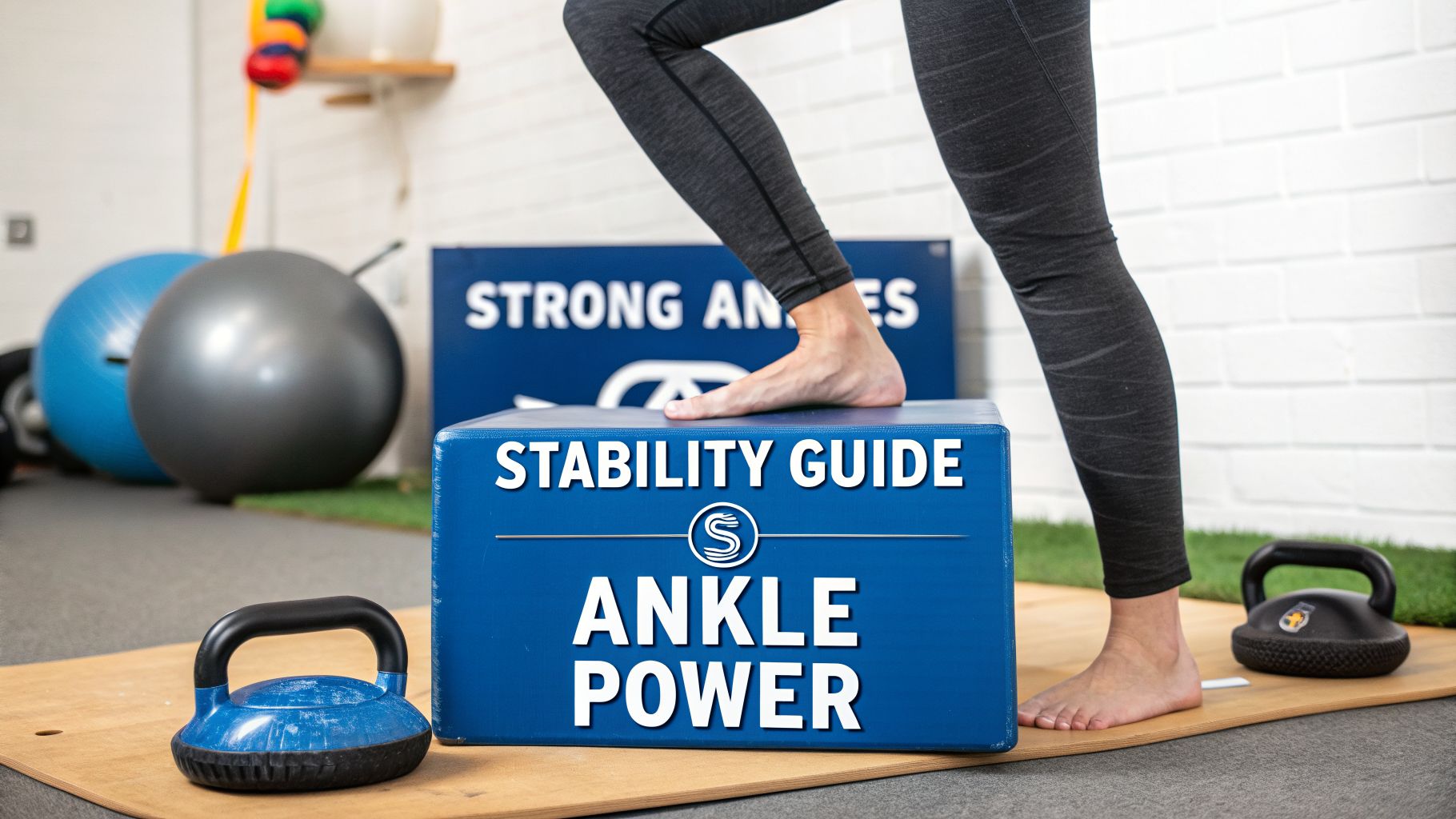
Building truly resilient ankles requires a plan that goes beyond simple stretches. It demands a focused combination of mobility, strength, and balance exercises designed to rebuild the muscles and ligaments that stabilize your joints. At Pure Motion Chiropractic, we guide our Chicago patients through this process every day, helping them dramatically cut their risk of sprains and boost their overall stability for a more active life.
Your First Step Toward Stronger Ankles in Chicago

If you’ve ever felt that unnerving wobble on an uneven Roscoe Village sidewalk or hesitated while playing with your kids at a local park, you know the frustration of weak ankles. It’s a common problem we see at our clinic, often stemming from an old injury, muscle imbalances, or ligaments that have been stretched one too many times.
This can lead to a frustrating cycle of repeat sprains and a general lack of confidence in your body. You might find yourself second-guessing a jog along the lakefront or avoiding pickup sports altogether for fear of another painful twist. At Pure Motion Chiropractic, we understand these concerns and are here to provide clear, effective solutions.
Why Your Ankle Stability Matters
Think of your ankles as the foundation of your body. When that foundation is shaky, it’s not just about your ability to walk or run. It sends a ripple effect up your entire kinetic chain, impacting everything from your knees and hips all the way to your spine—an issue we frequently address with comprehensive chiropractic care.
Here’s why taking weak ankles seriously is so critical:
- Injury Prevention: Stable ankles are far less likely to roll or sprain during activity. This is essential for anyone in our active Chicago community, from weekend warriors to parents trying to keep up with their kids.
- Improved Posture and Alignment: Ankle instability can force subtle shifts in how you stand and move. Over time, this can lead to chronic knee, hip, and even low back pain. Restoring ankle stability can help correct alignment from the ground up, a core principle of chiropractic treatment.
- Enhanced Performance: Whether you're a runner needing a powerful push-off or a dancer demanding precise control, strong ankles are non-negotiable. They provide the power and stability needed for efficient, effective movement in any activity.
Ankle sprains are incredibly common, affecting about 2 million people annually in the US. Without proper intervention, recurrence rates can be as high as 22%. The good news is that a major analysis found that structured, exercise-based rehab can slash the re-injury risk by a massive 40% compared to doing nothing.
Taking a Proactive Approach
You don't have to live with the fear of your ankle giving out. Weakness is not a life sentence. By proactively committing to a program of targeted exercises, you can rebuild that lost strength, sharpen your balance, and get your confidence back. This guide is built to give you the practical tools and a clear roadmap to do exactly that.
Whether you're recovering from a recent sports injury or have been dealing with shaky ankles for years, this program will help you build a more resilient foundation. Of course, if you're ever unsure about your symptoms or feel you need personalized guidance, learning when to consult a professional chiropractor can be a game-changing step in your recovery journey.
A Step-by-Step Exercise Plan for Ankle Stability
Building stronger, more resilient ankles isn’t about randomly doing a few exercises you saw online. It's a smart, progressive process. You need to systematically target mobility, then strength, and finally, proprioception—your brain's ability to sense where your ankle is in space without you having to look.
This is your playbook. We'll walk through the exact exercises you need, from foundational movements to more advanced drills. We'll also show you simple ways to make them easier or harder, so you can build strength safely, no matter your starting point.
Restore Your Range of Motion with Mobility Drills
Before you can build strength, you have to ensure the joint can move freely. If your ankle is tight and restricted, you're setting yourself up for an injury. These simple drills will help you restore fluid motion and prepare your ankles for the work ahead.
Ankle Circles:
Sit down on a chair or the floor and extend one leg. Slowly and deliberately rotate your foot clockwise, trying to make the biggest circle you can without any pain. It’s all about smooth, controlled movement. Do 15-20 rotations, then switch directions and go counter-clockwise. Repeat on the other side.
Alphabet Writing:
This is a physical therapy classic for a reason. While seated, lift your foot off the ground and pretend your big toe is a pen. "Write" out each letter of the alphabet in the air. This forces your ankle to move through all its different planes of motion in a controlled way, without any weight on it.
Build Foundational Power with Strengthening Exercises
Once you've opened up your range of motion, it's time to build strength in the muscles that act as your ankle's support system. This includes your calves, the tibialis anterior (the muscle on the front of your shin), and the peroneal muscles running along the outside of your lower leg.
Calf Raises:
This is a non-negotiable, fundamental exercise for ankle stability.
- Stand with your feet flat on the floor, about hip-width apart. You can hold onto a wall or chair for balance if you need it.
- Slowly lift your heels off the ground, pushing up through the balls of your feet. Pause for a second at the top.
- With control, lower your heels back down. Don't just let them drop!
- Aim for 3 sets of 15-20 repetitions.
- Make it easier: If that's too much, start by doing them while seated in a chair.
- Make it harder: Progress to doing them on one leg at a time. For an even bigger challenge, stand with your heels hanging off a step to increase the range of motion.
Heel Walks and Toe Walks:
These are fantastic for targeting the muscles on the front and back of your lower legs. Simply walk across the room for 30-60 seconds on your heels, keeping your toes pulled up high. Then, switch and walk for another 30-60 seconds on your tiptoes. Rest and repeat the cycle 2-3 times.
The Role of Isokinetic Training and Resistance
Bodyweight exercises are a great start, but adding targeted resistance is how you truly accelerate your progress. Resistance bands are common, but more advanced methods can offer even better results.
University studies have shown that isokinetic ankle training—where a machine controls the speed of your movement against a constant resistance—is significantly more effective than traditional resistance bands. In one 8-week trial, both concentric (muscle shortening) and eccentric (muscle lengthening) isokinetic training drastically outperformed bands in boosting explosive strength and dynamic balance.
Even if you don't have access to an isokinetic dynamometer, the takeaway is the same: controlled resistance is key. For a program built specifically for your body and goals, explore our guide on therapeutic exercises.
To help you choose the right tools, let's compare some common options. Different methods offer unique benefits, and what's best for you depends on your goals and what you have available.
Comparing Ankle Strengthening Techniques
| Technique | Primary Benefit | Best For | Accessibility |
|---|---|---|---|
| Bodyweight Exercises | Foundational strength and endurance | Beginners, warm-ups, and general conditioning | High (can be done anywhere) |
| Resistance Bands | Targeted muscle activation and control | Improving specific movement patterns | High (inexpensive and portable) |
| Wobble/Balance Boards | Proprioception and reactive stability | Intermediate/advanced balance training | Moderate (requires equipment purchase) |
| Isokinetic Dynamometer | Maximum strength gains, objective data | Advanced rehabilitation, performance training | Low (clinical setting only) |
Ultimately, the best technique is the one you'll do consistently. A mix of bodyweight, resistance band, and balance work is a powerful combination for most people looking to build resilient ankles.
Key Takeaway: Consistent, targeted strength work is non-negotiable. It fortifies the muscles that act as your ankle's natural brace, providing the stability needed to prevent rolls and absorb shock during activities like walking on uneven ground or playing sports.
Enhance Your Brain-Body Connection with Balance and Proprioception
Strengthening your muscles is only one piece of the puzzle. Proprioception is your body's "sixth sense"—that unconscious awareness of where your limbs are in space. After an injury, this connection gets fuzzy, which is a major reason why re-sprains are so common. These drills sharpen that mind-body link, training your muscles to react faster to prevent a fall or twist.
Single-Leg Stance:
This is the cornerstone of all balance training.
- Stand on one foot, keeping a slight, soft bend in your knee.
- Try to hold this position for 30 seconds without letting your other foot touch down or grabbing onto anything.
- Focus on keeping your hips level and your core tight.
- Switch legs and repeat. Aim for 3 sets on each side.
- Make it easier: Start by lightly holding onto a counter for support. As you get better, reduce your reliance on it until you don't need it at all.
- Make it harder: Close your eyes. This is a game-changer. It removes all visual cues and forces your body to rely purely on the feedback from your ankle, making it exponentially more challenging.
Single-Leg 4-Way Reach:
This drill adds a dynamic challenge to your balance work.
- Balance on your left leg, again with a soft knee.
- Slowly reach your right foot forward and lightly tap the ground. Return to the start.
- Next, reach your right foot out to the side and tap the ground. Return to the start.
- Finally, reach your right foot straight behind you and tap the ground.
- That whole sequence is one rep. Do 8-10 reps, then switch to the other leg. The key is to keep the movement slow and deliberate, focusing on total stability in that standing ankle.
By weaving these three types of exercises—mobility, strength, and balance—into a regular routine, you create a comprehensive system for rebuilding weak ankles from the ground up. This approach doesn't just fix the muscular weakness; it retrains the critical neurological pathways you need for long-term stability and, most importantly, confidence in every step you take.
Your 8-Week Ankle Strengthening Program
Knowing which exercises to do is one thing, but turning that knowledge into real, lasting strength requires a structured, consistent plan. At Pure Motion Chiropractic, we create personalized care plans for our patients. Below, we've laid out a practical 8-week program that builds on the drills we've covered, organizing them into a schedule that’s easy to follow.
This isn't just a random collection of exercises. The plan is designed to progress you safely, preventing overtraining while systematically building resilience. You'll start with the fundamentals and gradually layer on more demanding movements. The most important thing is to listen to your body—this program gives you the framework, but you are in control.
The Phased Approach to Building Resilience
We’ll tackle this in three distinct phases. You won't be jumping onto a balance pad on day one. Instead, we'll build a solid foundation first. This is non-negotiable for preventing re-injury and achieving the kind of stability that holds up in the real world.
- Phase 1: Mobility and Activation (Weeks 1-2): The main goal here is to restore your ankle's natural range of motion and "wake up" the key stabilizing muscles. Think gentle movement and building that mind-muscle connection.
- Phase 2: Strength Building (Weeks 3-5): Now we start adding resistance to make the muscles work harder. This is where you'll begin to feel tangible gains in strength and endurance.
- Phase 3: Dynamic Control and Proprioception (Weeks 6-8): The final phase is all about challenging your balance and coordination. We’ll train your ankles to react quickly to sudden shifts and uneven surfaces—the ultimate test of stability.
This timeline gives you a great visual of how we’ll move from foundational mobility, through strength work, and into those advanced balance drills.

The key takeaway is the sequence. You have to master pain-free movement before you can safely build strength and challenge your balance. Trying to skip ahead is a recipe for a setback.
Weeks 1-2: The Foundation Phase
For the first two weeks, your entire focus should be on consistency and perfecting your form. Aim to do these exercises 3-4 times per week, making sure to take at least one rest day between sessions. Never push into sharp pain. A feeling of muscle fatigue or a gentle stretch is exactly what you're looking for.
Focus: Mobility, Muscle Activation, and Pain-Free Movement.
- Ankle Circles: 2 sets of 20 smooth, controlled rotations in each direction (clockwise and counter-clockwise) per ankle.
- Alphabet Writing: 1 set of tracing the full alphabet with each foot. This is all about control, not speed.
- Seated Calf Raises: 3 sets of 20 repetitions. This is a great way to start firing up the calf muscles without the full load of your body weight.
- Single-Leg Stance (with support): 3 sets of holding for 30 seconds on each leg. Keep a hand lightly on a wall or chair for balance.
This phase is as much about retraining your brain as it is your ankle. It might feel simple, but you're laying down the crucial neurological pathways for all the progress to come. If you feel any pinching or sharp pain, that’s your body’s signal to ease off or consult a professional at our Chicago clinic.
Weeks 3-5: The Strength Building Phase
Your ankles should be moving better and the muscles are awake. Now it's time to build some real strength. We're going to dial up the intensity by using your own bodyweight as resistance and introducing more challenging movements.
Focus: Building Muscular Endurance and Strength.
Always start with your mobility drills (Ankle Circles, Alphabet Writing) as a warm-up.
- Standing Calf Raises (both feet): 3 sets of 15-20 repetitions. Really focus on the slow, controlled lowering part of the movement.
- Heel and Toe Walks: 3 sets of walking for 30 seconds each. This directly targets the muscles on the front and back of your lower leg.
- Single-Leg Stance (no support): 3 sets of holding for 30-45 seconds per leg. Try to do this without holding onto anything.
- Resistance Band 4-Way: 2 sets of 15 reps for inversion, eversion, dorsiflexion, and plantar flexion. Start with a light band.
Progress Tip: Once you can comfortably complete all your sets and reps of the standing calf raises, you're ready to try single-leg calf raises. This is a huge step up that dramatically increases the load and builds truly functional strength.
Weeks 6-8: The Dynamic Control Phase
This is the final and most advanced phase. The objective here is to get your ankles ready for the dynamic, unpredictable demands of sports and daily life. We're now combining the strength you've built with serious balance and coordination work.
Focus: Proprioception, Reactive Stability, and Real-World Readiness.
Don't forget a brief warm-up with your mobility drills.
- Single-Leg Calf Raises: 3 sets of 10-15 repetitions on each leg. If this is still too tough, just stick with the two-legged version.
- Single-Leg Stance on an Unstable Surface: 3 sets of holding for 30 seconds. A pillow or foam pad is perfect for this. It forces all those tiny stabilizer muscles to work overtime.
- Single-Leg 4-Way Reach: 3 sets of 8-10 full repetitions on each leg. This is a fantastic drill for improving dynamic balance and control.
- Box Jumps (low box) or 90-Degree Jump Turns: 3 sets of 8 jumps. Your entire focus should be on a soft, controlled landing. The landing is far more important than how high you jump.
Below is a table that neatly summarizes the entire 8-week progression. It's a handy reference to see how each phase builds upon the last.
Sample 8-Week Ankle Strengthening Progression
| Week | Focus Area | Example Exercises | Goal |
|---|---|---|---|
| 1-2 | Mobility & Activation | Ankle Circles, Alphabet Writing, Seated Calf Raises | Restore pain-free range of motion and activate key muscles. |
| 3-5 | Strength Building | Standing Calf Raises, Heel/Toe Walks, Banded Exercises | Build foundational strength and muscular endurance. |
| 6-8 | Dynamic Control | Single-Leg Calf Raises, Balance on Unstable Surface, Jumps | Improve proprioception and prepare for real-world demands. |
By the end of this program, you should feel a major difference in your ankle strength, stability, and your confidence in them. Remember, consistency trumps intensity every time. Stick with the plan, listen to your body, and celebrate the small wins.
If your progress stalls or you continue to feel unstable, it might be time for a professional look. A chiropractor in Chicago can provide an evaluation and create a plan tailored specifically to your needs.
Beyond Exercises: Lifestyle and Footwear Tips
While the exercises in your 8-week program are the engine of your recovery, the choices you make every day are the steering wheel. A holistic approach that includes smart lifestyle adjustments and proper footwear is what ensures your hard work translates into long-term stability and confidence.
Your exercise routine is only a small part of your day. The other 23+ hours have a massive impact on your ankle health. Paying attention to your shoes and daily habits provides a supportive environment that protects your ankles from setbacks and enhances the benefits of your strengthening program.
Choosing the Right Footwear for Ankle Support
The shoes you wear are your ankle's first line of defense against the unpredictable surfaces of daily life. The wrong footwear can undermine all your strengthening efforts, while the right pair can provide the crucial stability you're working so hard to build.
When shopping for shoes, whether for daily walks around Roscoe Village or for athletic activities, look for these key features:
- Firm Heel Counter: This is the stiff part at the back of the shoe that cups your heel. A rigid heel counter prevents your foot from rolling inward or outward, providing essential rearfoot stability.
- Torsional Rigidity: Try to twist the shoe like you're wringing out a towel. A good, supportive shoe should resist this twisting motion. Too much flexibility means less support for your midfoot and ankle.
- Supportive Midsole: The midsole should be cushioned but not overly soft or "mushy." It needs to provide a stable platform that absorbs shock without feeling like you're walking on a pillow.
Our team at Pure Motion Chiropractic often advises patients to avoid shoes that are overly flexible, visibly worn-out, or have a soft, collapsible heel. These can actively contribute to the very instability you're trying to correct.
The Role of Custom Foot Orthotics
Sometimes, even the best off-the-shelf shoes aren’t enough to address underlying biomechanical issues. If you have flat feet, high arches, or other structural variations, your foot mechanics might be placing consistent, uneven stress on your ankle ligaments. This is where custom orthotics can be a game-changer.
Unlike generic, one-size-fits-all insoles from a drugstore, custom foot orthotics are specifically molded to your feet. They are designed to correct your unique biomechanical imbalances, providing support exactly where you need it to realign your foot and ankle.
This correction can dramatically reduce the strain on your ankle ligaments, improve your overall alignment from the ground up, and make your strengthening exercises far more effective. At Pure Motion Chiropractic, we specialize in assessing foot mechanics and creating personalized solutions. You can learn more about how our custom foot orthotics in Chicago can be part of a comprehensive plan for how to strengthen weak ankles.
Smart Lifestyle Adjustments for Ankle Health
Finally, small changes in your daily habits can make a big difference in preventing re-injury and supporting your recovery. This is about building awareness.
Integrate these simple practices into your routine:
- Mind Your Surfaces: Be extra cautious when walking on uneven ground like cobblestones, grassy fields, or cracked sidewalks. Consciously engaging your muscles on these surfaces can act as a mini-workout for your proprioception, but you have to be paying attention.
- Always Warm-Up: Before any significant physical activity—even just a brisk walk—take five minutes for some of the mobility drills from your program, like ankle circles or alphabet writing. This simple step prepares the joint for movement and reduces injury risk.
- Listen to Your Body: This might be the most important tip of all. If your ankle feels tired, sore, or unstable, don't push through it. Rest is a critical part of the strengthening process. Ignoring these signals is one of the fastest ways to have a setback.
When to See a Chiropractor for Your Weak Ankles
Self-guided exercise programs are a fantastic way to take control of your ankle health. But what happens when you’ve been diligently doing your calf raises and single-leg balances, yet your ankle still feels weak, or you’re still getting those unnerving, painful rolls?
This is a clear signal that it’s time to seek professional guidance from a chiropractor. Recognizing when to ask for help is a crucial step in strengthening your ankles safely and effectively. Pushing through persistent pain or instability can lead to more significant injuries and longer, more complicated recovery periods. Think of our team at Pure Motion Chiropractic as your trusted local partners in this journey—we can provide a detailed map when you feel you’ve lost your way.
Red Flags That Signal It's Time for Expert Help
If you're doing the exercises and your progress has stalled—or worse, you're experiencing new issues—don't just push through it. These are signs that there’s likely an underlying problem that at-home exercises alone can't fix.
Keep an eye out for these specific red flags:
- Persistent Pain: You should feel muscle fatigue during exercises, but sharp, lingering, or increasing pain that doesn't improve with rest is a major warning sign.
- Recurrent Sprains: You're following the program, but you still sprain your ankle during normal activities. This indicates that the instability is more significant than basic exercises can handle.
- A Feeling of 'Giving Way': If your ankle suddenly buckles or feels like it's going to collapse for no apparent reason, it’s a sign of significant ligament laxity or poor neuromuscular control.
- Swelling or Bruising Without Obvious Injury: Unexplained swelling or bruising can point to chronic inflammation or a more serious underlying condition that needs a proper diagnosis.
Ankle instability isn't just an occasional nuisance; it can become a chronic condition. For individuals with chronic ankle instability (CAI), the fear of movement and recurrent sprains can significantly impact daily life, a common concern for active Chicagoans, from athletes to busy workers.
What a Professional Diagnosis Offers
Coming to see us at Pure Motion Chiropractic in Roscoe Village isn’t about starting over; it’s about getting targeted, expert support to elevate your recovery. The first step is always a thorough diagnosis.
A hands-on assessment allows a trained professional to pinpoint the exact source of your weakness. We can identify which specific ligaments are overstretched, which muscles aren’t firing correctly, and whether there are alignment issues in your foot, ankle, or even further up the kinetic chain in your knee, hip, or spine. This detailed evaluation rules out more serious issues and forms the basis of a truly personalized treatment plan.
This professional insight is particularly important for conditions like chronic ankle instability. In fact, research combining data from multiple trials found that a specific blend of neuromuscular and strength training was the most effective protocol for improving muscle function in patients with CAI. This 'ground-up' approach, targeting the ankle first, is exactly the kind of focused care a professional can provide. You can explore more about these advanced training protocols in this detailed analysis from Frontiers.
Your Personalized Treatment Plan
Once we have an accurate diagnosis, we create a plan that goes far beyond generic exercises. Your personalized plan at Pure Motion Chiropractic may integrate several powerful approaches to get you back on your feet.
Here’s what your patient experience might look like:
- Chiropractic Adjustments: Gentle adjustments can restore proper alignment in the ankle and foot, as well as in the knee, hip, and spine, ensuring your entire body is working together harmoniously.
- Guided Therapeutic Exercises: We’ll move beyond the basics, introducing advanced exercises and ensuring your form is perfect to maximize results and prevent injury.
- Custom Foot Orthotics: If biomechanical issues are contributing to your instability, custom-molded orthotics can provide the foundational support your ankles need to heal and strengthen.
Seeking professional help isn’t a sign of failure—it's a smart, proactive step toward a faster, safer, and more complete recovery. It’s the next logical step when DIY methods are no longer enough to get you back to moving confidently and pain-free.
Common Questions About Strengthening Weak Ankles
As you start working toward stronger, more stable ankles, some questions are bound to pop up. Feeling a little uncertain is totally normal, but having clear, trustworthy answers is what keeps you confident and consistent. Here are some of the most common questions our patients at Pure Motion Chiropractic ask when they begin their journey.
How Long Does It Take to Strengthen Weak Ankles?
This is usually the first thing people want to know, and the honest answer is: it depends on your starting point and how consistent you are. You’ll probably start to feel a real difference in your stability and confidence within the first 2 to 4 weeks. This initial progress is mostly your nervous system getting smarter and faster at firing up the right muscles.
Building significant, lasting strength in the actual ligaments and muscles, however, takes a bit longer. For those more durable, substantial results, you should plan on a commitment of 8 to 12 weeks. And remember, once you’ve built that strength, keeping it up with a few sessions a week is the key to making sure you don't slide backward.
Can I Strengthen My Ankles if I Have Arthritis?
Yes, you absolutely can—but the approach needs to be smarter and gentler. If you have arthritis, high-impact exercises can easily aggravate the joint. The goal shifts to low-impact movements that build support without causing a flare-up.
A modified approach looks a little something like this:
- Focus on Range of Motion: Gentle ankle circles and "writing" the alphabet with your foot are fantastic for keeping the joint mobile without stress.
- Use Water for Resistance: Walking in a pool or doing water aerobics provides great resistance without the harsh impact of solid ground.
- Try Seated Exercises: You can do plenty of resistance band exercises while sitting down. This lets you strengthen all the muscles around the ankle without putting weight on the joint itself.
It's always a good idea to consult a professional before you start. A chiropractor can help design a safe, effective plan tailored to your specific condition, ensuring you get all the benefits without the pain.
Is It Normal to Feel Pain When Doing Ankle Exercises?
It's really important to know the difference between muscle fatigue and joint pain. Feeling your muscles get tired or experiencing a gentle stretch is perfectly normal. That’s how you know they're working.
However, you should never feel sharp, shooting, or increasing pain during or after an exercise. Pain is your body's alarm bell, telling you to stop immediately. It could mean your form is off, the exercise is too advanced for you right now, or there's an underlying issue that needs a professional eye, like one of our providers here in the Chicago area.
Should I Wear an Ankle Brace While Exercising?
Ankle braces can be a great tool, but they aren't a long-term fix for weakness. A brace offers external support, which can be invaluable right after an acute injury. It helps protect the healing tissues and prevents you from rolling the ankle again.
But the whole point of a strengthening program is to make your muscles become the brace. Relying on a brace for too long can turn it into a crutch, stopping your own stabilizing muscles from ever getting strong enough. Think of it as a temporary training wheel, not a permanent solution.
If you have questions that weren't on this list or you feel like your progress has stalled, it’s a good sign that some personalized guidance could make all the difference. The team at Pure Motion Chiropractic is passionate about helping our Roscoe Village community move better and live without pain.
Ready to build confident, stable ankles? Schedule your appointment with us today!