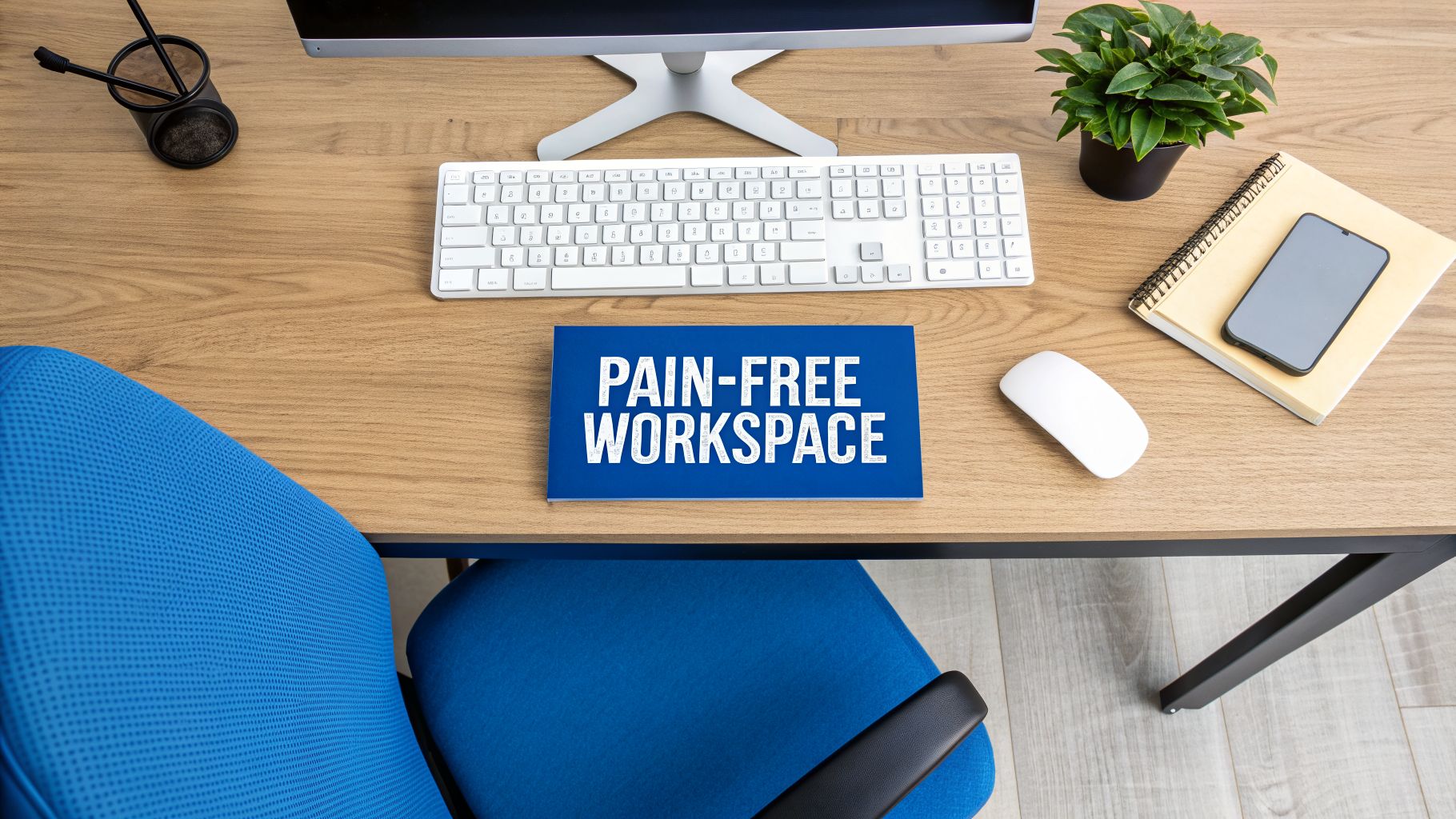
When it comes to preventing a repetitive strain injury (RSI), the strategy is surprisingly straightforward. It all boils down to a few key areas: setting up your workspace so your body is in a neutral, supported posture, weaving frequent movement breaks into your day, and building strength in the muscles that get you through your daily grind.
This isn't about reacting to pain—it's about getting ahead of it. At Pure Motion Chiropractic, we are passionate about empowering our community with the knowledge to stay healthy and avoid injury in the first place.
The Real Impact Of Repetitive Strain Injury
That familiar ache in your wrist or the nagging stiffness in your shoulder after a long day? It’s easy to brush off as just a minor inconvenience, but it could be the first whisper of a repetitive strain injury (RSI). We see this all the time with our patients, from office workers in the Loop to active folks in Lakeview. These injuries are sneaky, developing slowly from all those small, repeated motions we do without even thinking—endlessly scrolling on a phone, clicking a mouse, or even just carrying groceries with poor form.
This is much more than a personal nuisance, though. The problem is massive. Did you know that job-related RSIs are responsible for a staggering $20 billion in workers' compensation costs each year? On top of that, they account for another $100 billion in lost productivity and other related expenses. Those numbers paint a clear picture of just how disruptive these injuries can be on a larger scale. You can learn more about the economic impact of RSIs from the Centers for Disease Control and Prevention.
At Pure Motion Chiropractic, we see the human stories behind those statistics every day. We work with people from Roscoe Village and the surrounding neighborhoods who are struggling with the pain, numbness, and weakness that can derail both their careers and their daily lives. We are here to reassure you that there are effective, non-invasive solutions.
Understanding How RSIs Develop
Repetitive strain injuries don't just appear out of the blue. They're the result of cumulative stress—tiny bits of trauma that build up in your muscles, tendons, and nerves over weeks, months, or even years.
Think of it like a rope fraying, one single thread at a time. Each repetitive movement adds just a little bit more strain. Eventually, that accumulated stress leads to inflammation, pain, and real tissue damage.
A few common culprits are almost always at play:
- Prolonged static postures: Just sitting at a desk for hours on end is a huge one. It forces some muscles to stay tense and overworked while others get weak from disuse.
- Repetitive tasks: This is the obvious one. Typing, clicking a mouse, working an assembly line, or even playing an instrument involves doing the exact same motion over and over and over again.
- Awkward positions: Think about how you hold your phone to your ear, crane your neck to look at a poorly positioned monitor, or use a tool that bends your wrist at a weird angle. All of these seemingly small things add up.
The most important thing to remember is that RSIs are largely preventable. By making small, intentional changes to your environment and daily habits, you can dramatically cut your risk of developing these painful and limiting conditions.
Whether you're in Roscoe Village or Logan Square, simply being aware of these risk factors is the first critical step. The goal isn’t to stop doing your job or enjoying your hobbies—it’s to learn how to do them in a way that doesn't harm your body. Our approach here at Pure Motion Chiropractic is twofold: we focus on treating your current pain while also giving you the knowledge and tools to keep it from coming back.
Here's a snapshot of the core strategies for preventing RSIs, providing an at-a-glance guide for immediate action.
Your Quick-Start RSI Prevention Checklist
| Prevention Pillar | Key Action | Why It Matters |
|---|---|---|
| Ergonomics | Adjust your chair, desk, and monitor to support a neutral posture. | Reduces constant strain on your neck, back, and wrists by aligning your body properly. |
| Movement | Take a 30-60 second "microbreak" every 30 minutes to stand and stretch. | Interrupts static postures, improves blood flow, and gives overworked tissues a rest. |
| Strengthening | Perform targeted exercises for your core, back, and wrists a few times a week. | Builds endurance in stabilizer muscles, making them more resilient to daily demands. |
| Habits | Vary your tasks and be mindful of your posture throughout the day. | Prevents the same muscle groups from being overused and reduces cumulative stress. |
This checklist isn't just a set of rules; it's a framework for building healthier habits that protect your body for the long haul. Starting with even one or two of these actions can make a significant difference.
Building Your Ergonomic Workspace
Think of your desk setup as your first line of defense against repetitive strain injury. It’s the foundation for a pain-free workday. Whether you’re working from a home office in Logan Square or a high-rise in downtown Chicago, getting your ergonomics right is non-negotiable.
This isn't about splurging on a fancy, high-tech chair. It's about simple, smart adjustments that position your body to minimize the tiny, daily stresses that add up to big problems like carpal tunnel and tendonitis.
The goal is to find a neutral posture—that sweet spot where your joints are naturally aligned and your muscles can finally relax.
A great rule of thumb we teach our patients at Pure Motion Chiropractic is the 90-90-90 rule. Your elbows, hips, and knees should all form something close to a 90-degree angle. Your feet need to be flat on the floor (no dangling!) and your lower back should feel supported by your chair.
Setting Up Your Monitor and Keyboard
Once you're sitting comfortably, it's time to arrange your equipment.
Your monitor belongs directly in front of you. A common mistake we see in our practice is a monitor that's too low, forcing you to hunch over all day. The top of your screen should be at or just a bit below eye level. This one change can make a huge difference in preventing that nagging neck and shoulder pain.
Now, let's talk about your keyboard and mouse. Their placement is just as important for protecting your wrists and hands.
- Keyboard Position: Bring your keyboard close enough that your elbows stay by your sides, maintaining that 90-degree bend. Your wrists should be straight and relaxed, not bent up, down, or to either side.
- Mouse Position: Keep your mouse right next to your keyboard. If you have to constantly reach for it, you’re putting a ton of extra strain on your shoulder.
An adjustable chair isn’t a luxury; it's a necessity for anyone working at a desk. The ability to fine-tune your seat height, backrest, and armrests is fundamental to reducing the cumulative stress that leads to injury.
This simple guide shows how the three pillars of RSI prevention—ergonomics, movement, and strength—all work together.

Remember, a perfect desk setup is a great start, but it's only truly effective when you also build in regular movement and breaks.
Practical Fixes for Any Workspace
You don’t have to remodel your office to make it more ergonomic. Sometimes, all it takes is a little creativity.
Are your feet dangling? Grab a small box or a stack of thick books to use as a footrest. Is your laptop screen too low? Prop it up on a ream of paper or a monitor stand to get it to eye level. The entire point is to make your environment fit you, not the other way around.
Good posture is the bedrock of a healthy, pain-free body. If you feel like you're constantly fighting to sit up straight, you can learn more about how to fix poor posture in our detailed guide.
One last tip: check your lighting. A well-lit workspace reduces eye strain, which keeps you from subconsciously leaning forward and ruining that perfect posture you just set up.
Making Time for Movement and Mindful Breaks
You can have the fanciest ergonomic setup in the world, but if you're stuck in it for eight hours straight, you're still heading for trouble. We see it time and again in our practice: static posture is one of the biggest culprits behind repetitive strain. When you hold one position for too long, some muscles stay constantly tensed up while others get weak and lazy. The best way to break that cycle is surprisingly simple—just move.

What we always tell our patients at Pure Motion Chiropractic is that frequency beats duration, every time. It’s the short, consistent breaks that really interrupt the cycle of strain and stop an injury before it starts. And this is no small problem; in the US, these kinds of injuries make up nearly one-third of all worker injury cases. Globally, hundreds of thousands of people are affected each year by work-related upper limb disorders, as detailed in some great insights on the prevalence of repetitive strain injuries at JamesSextonLaw.com.
How to Weave Microbreaks Into Your Day
The key is to build small, non-negotiable habits into your existing routine. You don't need to block out an hour for a workout in the middle of your day.
A great place to start, especially if you get eye fatigue, is the 20-20-20 rule. It’s easy: every 20 minutes, you look away from your screen at something about 20 feet away for at least 20 seconds. This little reset for your eye muscles does wonders for preventing you from hunching forward to squint at your monitor.
Beyond that, try to get up for at least a minute every half-hour. A simple timer on your phone is all you need. When it buzzes, stand up. Maybe you’ll walk to the kitchen for a glass of water or just do a quick stretch right there at your desk. That simple act resets your posture, gets the blood flowing, and gives those overworked muscles a moment of relief.
Simple Desk Stretches That Actually Work
During those microbreaks, a few targeted stretches can directly counteract the stress your body is under. These are our go-to recommendations because they're quick, effective, and safe.
- Wrist Flexor Stretch: Hold one arm out, palm up. With your other hand, gently press your fingers down toward the floor until you feel a light stretch in your forearm. Hold for 15-20 seconds. This is the perfect antidote to all that typing and mousing.
- Neck Retraction (Chin Tucks): Sit tall and gently pull your head straight back, as if you’re trying to make a double chin. This feels a bit awkward, but it’s fantastic for strengthening the deep neck muscles that get overstretched from staring at a screen.
- Shoulder Rolls: This one is as easy as it sounds. Lift your shoulders up toward your ears, then roll them back and let them drop down. You’ll feel that built-up tension in your upper back and neck just melt away.
Here’s a pro tip we share with all our patients: the goal is gentle relief, not a full-blown workout. You should only feel a mild pull, never pain. Doing these gently and consistently is far more beneficial than pushing it too hard once in a while.
Don't forget the mental side of things, either. When we're stressed, our muscles tense up, making us prime candidates for injury. Just taking a few moments for some deep, slow breaths during your breaks can signal your nervous system to calm down, relaxing your body in the process. If you want to explore this further, we have a helpful guide where a chiropractor describes stretching in more detail.
Strengthening Your Body Against Daily Strain
A great ergonomic setup and regular breaks are crucial, but they're only part of the story. To truly get ahead of repetitive strain, we need to build a body that’s more resilient to the demands we place on it every day. This means strengthening the specific muscles that support your most vulnerable areas—the wrists, shoulders, and back.

Think about it: the muscles that hold you upright are on the clock all day long. If they're weak, they fatigue easily. That's when you start to slump, hunch over your keyboard, and put all that extra, damaging stress on your tendons and nerves. A little bit of strength training builds a much stronger internal foundation.
Simple Exercises for Hands and Wrists
When you type, text, or even just grip a steering wheel, the small muscles in your hands and forearms are doing all the work. Keeping them strong is one of the best ways to fend off issues like carpal tunnel syndrome. And the best part? You can do these exercises just about anywhere.
- Grip Strengthening: Find a stress ball or a tennis ball and squeeze it firmly for 3-5 seconds, then relax. Aim for 10-15 repetitions with each hand. It’s a surprisingly effective way to build the endurance your gripping muscles need.
- Gentle Wrist Curls: Rest your forearm on a desk or table, letting your hand hang off the edge with your palm facing up. Using a very light weight (a can of soup works perfectly) or no weight at all, slowly curl your wrist toward the ceiling. Lower it back down and repeat 10-15 times to target the forearm flexor muscles.
With these exercises, consistency beats intensity every time. The goal is to build endurance, not to bulk up. A few minutes each day will do far more good than a single, strenuous session once a week.
Building Core and Back Strength for Better Posture
Your core is so much more than just your abs. It's the entire muscular network of your torso—including your back and hips—that supports your spine. When your core is strong, it acts like a natural corset, stabilizing your body and taking the load off your neck and shoulders.
At Pure Motion Chiropractic, a huge part of our work is developing personalized exercise plans that create long-term stability. This focus on foundational strength is something we emphasize for everyone, from busy parents to dedicated athletes here in North Center. Simple moves like planks and bird-dog poses are fantastic because they strengthen the deep stabilizer muscles that allow you to sit and stand tall without a second thought.
Recognizing Warning Signs and When to Seek Help
It’s easy to brush off that little ache in your wrist. We’ve all been there—shaking out our hands after hours of typing or rubbing a stiff neck, writing it off as just another part of the daily grind. But those seemingly minor signals are your body’s early warning system.
Listening to them is probably the most important thing you can do to stop a small annoyance from turning into a chronic, life-altering problem. Catching a repetitive strain injury early is everything. The first signs are often subtle, but they're critical clues that something isn't right.
Does any of this sound a bit too familiar?
- A stubborn ache, tenderness, or stiffness in your hands, wrists, or shoulders.
- That pins-and-needles feeling or numbness, especially at night or right after a specific task.
- Your grip feels weaker, making it tough to open a jar or even hold a coffee mug.
- You find yourself constantly shaking out your hands or stretching your neck to find relief.
These aren't just signs of a long day. They're classic red flags of cumulative strain on your muscles, tendons, and nerves.
Why You Shouldn't "Tough It Out"
When you first notice that tingling or dull ache, it's a sign that the micro-damage from repetitive movements is starting to win. Your body just can't keep up with the repairs. Pushing through the pain is like driving on a tire with a slow leak—sooner or later, you're going to end up stranded.
Ignoring these warnings allows inflammation to set in, scar tissue to form, and nerve pathways to become seriously irritated. What starts as a simple case of tendonitis can easily snowball into a more severe condition like carpal tunnel syndrome, which is a much bigger battle to fight. Our guide on understanding and treating carpal tunnel dives deeper into how this progression happens.
That initial discomfort isn't something to ignore; it's your window of opportunity. It’s your chance to take action and reverse the damage before it becomes a permanent part of your life.
When to Bring in a Professional
So you've tweaked your ergonomic setup, you're taking regular breaks, but you're still dealing with persistent symptoms. Now is the time to get a professional diagnosis. Trying to fix it yourself can only get you so far, and a proper assessment is the only way to get to the root cause of your pain.
At Pure Motion Chiropractic, we see people from all over Chicago—including Roscoe Village and Lincoln Square—who are looking for real answers and a clear path forward. Your first visit with us isn't about a quick, temporary fix. It's a deep dive. We start by listening to your story: what your days look like, exactly where it hurts, and how it’s affecting your life.
From there, we conduct a thorough physical exam to check your posture, joint mobility, and muscle function. This helps us pinpoint the why behind the pain. Armed with that knowledge, we build a personalized care plan that doesn’t just chase symptoms. We aim to correct the underlying imbalances that started the problem in the first place.
This might include targeted chiropractic adjustments to restore proper joint movement, therapeutic massage to release painfully tight muscles, and a specific exercise program to build lasting strength. Don't wait for the pain to become unbearable. Taking proactive steps today is your best bet for a pain-free future.
Your Chicago Partner in a Pain-Free Life
Hopefully, you're now feeling equipped with some real, practical strategies for preventing repetitive strain injuries. Making your workspace more ergonomic, remembering to move your body throughout the day, and building a bit of foundational strength are your best defense against the aches and pains that creep in from daily life.
But what happens when the pain is already a persistent, unwelcome guest? While these preventative tips are fantastic, once discomfort has set in, you really need a professional to pinpoint the root cause. This is where getting a personalized plan can make all the difference.
Your Wellness Partner in Roscoe Village
Here at Pure Motion Chiropractic, we’re not just another clinic. We’re part of the fabric of this community, proudly serving our neighbors in Roscoe Village, Lakeview, North Center, and Logan Square. We fundamentally believe that you shouldn't have to just "live with" pain or discomfort. Our goal is simple: to help you understand your body, take back control, and get back to living a life without limitations.
We know life is busy, so we make it as easy as possible to take care of yourself. With early morning and late evening appointments available, plus free on-street parking, fitting a visit into your schedule is one less thing to worry about. You'll feel our patient-first approach the moment you step through our doors.
We don’t just chase symptoms. We build relationships and create care plans that restore mobility, build confidence, and help you and your family stay well for the long haul.
Stop Tolerating Discomfort and Start Healing
When you come to Pure Motion Chiropractic, you're choosing a clear, organized path to feeling better. We combine precise chiropractic adjustments with therapeutic massage and one-on-one guidance to tackle what's really going on. For one person, that might mean releasing the stubborn muscle tension that’s causing their headaches. For another, it could be correcting the joint dysfunction behind their nagging back pain or creating a strengthening program to keep a future RSI at bay.
You don't have to keep toughing it out or telling yourself that pain is just a normal part of getting older or working at a desk. The first step toward real, lasting relief is getting a clear diagnosis and a straightforward plan to fix it.
Take that first step. Schedule your New Patient Special for a comprehensive assessment and let's start the journey toward restoring your mobility. It's time to move better, feel better, and live pain-free.
Frequently Asked Questions About Repetitive Strain Injury
Can Chiropractic Care Really Fix A Repetitive Strain Injury?
It absolutely can. When we see patients with RSI at Pure Motion Chiropractic, we find the issue is rarely just in the muscle. It’s often a combination of joint restriction, muscle tension, and underlying weakness that created the problem in the first place.
Our approach is to look at the whole picture. We use specific chiropractic adjustments to get your joints moving correctly again, hands-on therapy to release the knots and tightness in the strained muscles, and custom exercises to rebuild strength. This multi-faceted care helps ensure the injury not only heals but is also far less likely to come back.
I Work At A Desk But I Am Not In Pain. Should I Still Worry About RSI?
This is a fantastic question, and the short answer is yes. Think of RSI like a slow leak; you often don't notice the damage until the puddle is already on the floor. These injuries are the result of thousands of tiny, repetitive movements adding up over months or even years.
You might not feel pain now, but the strain is likely accumulating. Being proactive is key. Simple changes to your ergonomic setup and a few daily stretches can head off a serious, painful problem down the road. A quick, preventative check-in at our Roscoe Village clinic can help spot these risks before they ever have a chance to cause you pain.
How Long Does It Take To Recover From An RSI?
Recovery time really depends on a few key factors: how severe the strain is, how long you've been feeling symptoms, and your body's unique healing capacity. It’s not a one-size-fits-all timeline.
In our experience, a minor strain that’s caught early might feel significantly better within a few weeks of consistent care. However, a more chronic condition that has been ignored for months could take several months to resolve fully. At Pure Motion Chiropractic, we’ll map out a clear, personalized plan with you, setting realistic goals to get you back to doing what you love without pain.