Fixing forward head posture is a journey that involves a mix of self-awareness, dedicated exercises, smarter daily habits, and, for many in Chicago, professional guidance. By practicing simple exercises like chin tucks, stretching tight chest muscles, and adjusting your workspace, you can start retraining your body to find a healthier, more comfortable alignment. This guide, brought to you by Pure Motion Chiropractic, will walk you through how to get started on the path to relief from neck pain and improved posture right here in your community.
The Hidden Costs of Tech Neck in Chicago

If you spend your days hunched over a laptop or endlessly scrolling on your phone, you're not alone. Forward head posture, often called "tech neck," has become a common sight for professionals, students, and remote workers across Chicago.
You see it everywhere—on the 'L' train, in Lakeview coffee shops, and at home office desks from Logan Square to North Center.
But this isn't just about how you look; it's a genuine health concern that our local community faces. That forward jut of your head is directly tied to the chronic neck pain, nagging headaches, and persistent shoulder tension that so many people accept as normal. Here at Pure Motion Chiropractic in Roscoe Village, we help patients every day who are dealing with the painful effects of this modern-day problem. We're here to reassure you that there are effective solutions.
A Modern Problem with Real Consequences
The numbers behind forward head posture are startling. Research has found that roughly 73% of university students and 61.3% of office workers show signs of it.
When you consider that other studies show about 78% of people hold their neck in a stressful position at some point during a 24-hour period, it's clear our modern habits are piling on the strain. With the overall prevalence of neck pain in the general population hitting as high as 86.8%, it’s no wonder so many are searching for a "chiropractor near me" for effective relief.
This constant strain isn't just an annoyance. It’s a key driver behind many of the "unexplained" aches that disrupt your life.
At its core, forward head posture is a symptom of our environment. The long hours we spend sitting, driving, and looking down at screens create a cumulative stress that our bodies simply weren't designed to handle.
Why You Can’t Afford to Ignore It
It's easy to dismiss neck pain as just another part of a busy Chicago life. But ignoring the root postural problem only allows it to become more ingrained, making it much harder to correct down the road.
Over time, this imbalance can lead to some serious issues:
- Chronic Pain: That never-ending ache in your neck, upper back, and shoulders.
- Tension Headaches: Pain that often creeps up from the base of your skull.
- Reduced Mobility: Stiffness that makes it a chore just to turn your head.
- Long-Term Spinal Stress: Increased wear and tear on the delicate joints in your neck.
To help you get started, here's a quick overview of the key strategies we'll be diving into.
Quick Guide to Fixing Forward Head Posture
Here's a quick overview of the key strategies we'll cover to help you start correcting forward head posture.
| Strategy | Key Action | Why It Works |
|---|---|---|
| Self-Awareness | Regularly check your posture | Builds the habit of recognizing and correcting your alignment throughout the day. |
| Corrective Exercises | Perform chin tucks and wall angels | Strengthens weak neck muscles and stretches tight chest muscles to restore balance. |
| Ergonomic Tweaks | Adjust your monitor height | Reduces the need to look down, keeping your head aligned over your shoulders. |
| Daily Habit Changes | Take frequent screen breaks | Interrupts the cycle of sustained forward head posture and reduces muscle strain. |
These steps form the foundation of a solid recovery plan.
At Pure Motion Chiropractic, our goal is to give you a clear, reassuring path back to feeling good. That journey starts with understanding why your posture is so critical for your long-term wellness. We know that many issues tied to poor posture are made worse by our sedentary habits. You can learn more about how to fight back in our article about the sitting epidemic.
Why Your Neck and Shoulders Are Always Aching

Ever wonder why your neck and shoulders seem to carry a constant, nagging ache? It’s not just in your head—and it's definitely more than just "stress." The real reason often comes down to simple physics and the surprising weight of your own head.
When balanced correctly over your spine, your head weighs about 10 to 12 pounds. But for every single inch your head juts forward, the effective weight on your neck muscles multiplies.
Think about holding a bowling ball. If you keep it close to your chest, it’s manageable. Now, try holding that same ball with your arms extended straight out. The strain is immediate and intense. That’s exactly what your neck and upper back muscles are doing all day long when your head is out of alignment.
The Modern Habits Fueling the Strain
This postural imbalance doesn't just happen overnight. It’s the slow, creeping result of daily habits that pull your head forward and away from its natural home. Many of our patients at Pure Motion Chiropractic in Roscoe Village are surprised to learn how these seemingly harmless activities are the source of their pain.
Common culprits we see every day include:
- Prolonged Screen Time: Leaning into a computer monitor or—more commonly—looking down at a phone for hours forces your neck into a strained, flexed position.
- Awkward Sleeping Positions: Using too many pillows or sleeping on your stomach can twist and push your head forward, leaving you stiff and sore by morning.
- Driving for Commutes: Slouching in the driver's seat, a frequent posture during long Chicago commutes, encourages your head to drift forward to see the road.
- Reading or Hobbies: Looking down at a book, knitting, or any hobby that keeps your gaze lowered for long stretches adds to the cumulative stress.
These activities weaken the muscles in your upper back while overtightening the muscles in your chest and the front of your neck. It creates a muscular tug-of-war that your spine is destined to lose.
Connecting Posture to Your Symptoms
This isn't just about temporary discomfort; it's a cascade of symptoms that can degrade your quality of life. The link between your neck’s angle and the pain you feel is well-documented. Maintaining that forward-leaning position dramatically increases the load on your cervical spine, leading to a host of clinical issues.
We're talking about chronic tension headaches, persistent neck soreness, and tight, ropy knots in your shoulders. It can even lead to pain that radiates down your arms as pins and needles or numbness. You can discover more about these findings on postural strain and how deeply it impacts the body.
The constant strain from forward head posture often creates painful knots in your muscles known as trigger points. These tight spots can refer pain to other areas, like the base of your skull, causing stubborn headaches. If you're struggling with these, you can learn more about trigger point therapy in our detailed guide.
The ache in your neck isn't just muscle fatigue. It’s a signal from your body that its support structures are overloaded and struggling to keep up.
Ultimately, the goal is to prevent long-term damage. When the vertebrae in your neck are constantly under abnormal stress, it can accelerate wear and tear on your joints and discs. This may lead to more serious conditions like degenerative disc disease or nerve impingement down the road. Addressing your posture now is a proactive step toward protecting your spinal health for years to come.
Try This Simple Posture Self-Check at Home
Before we dive into the nitty-gritty of corrective exercises, let's get a real-world sense of where your posture is right now. You don't need any fancy tools—in fact, one of the most eye-opening ways to check your head and neck alignment is something you can do in the next 60 seconds with a plain old wall.

This simple check-in isn't about giving you a formal diagnosis. Think of it more as a moment of awareness—an "aha!" that helps you connect what you feel with what's actually happening in your body. That connection is the real first step toward making a lasting change.
How to Do the Wall Test
Ready? Go find an empty wall in your house or office.
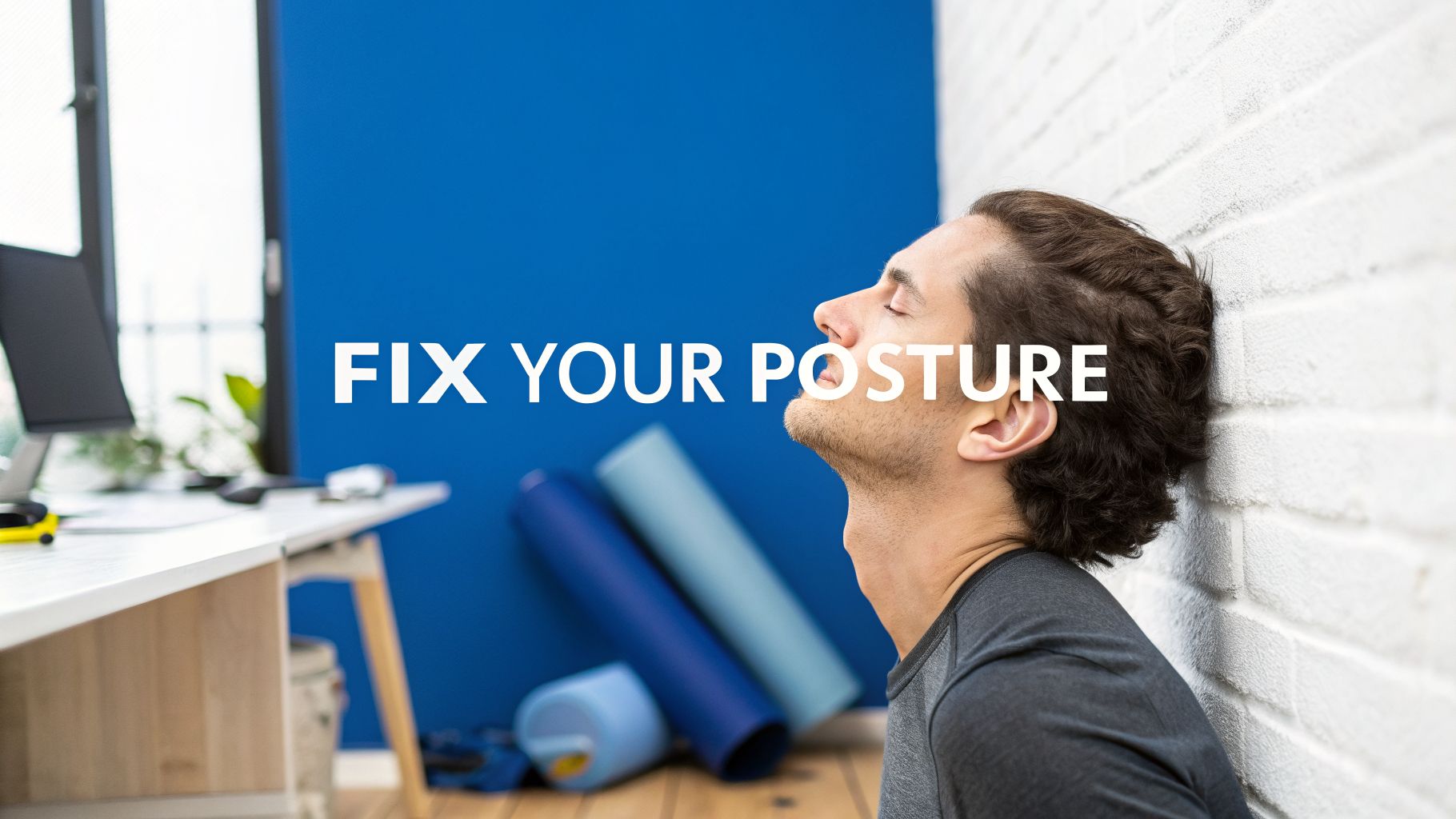
Stand with your heels about six inches away from the wall. Now, lean back until your tailbone and your shoulder blades are both resting firmly and evenly against it.
This is your starting point. Now, just relax and let your head fall back naturally toward the wall. The big question is: does the back of your head touch the wall?
- If your head touches easily: That's great! It suggests your head is in a pretty good neutral position over your shoulders and spine.
- If your head doesn't touch at all: This is a strong clue that you're dealing with forward head posture. The size of that gap shows you just how much your head has drifted forward from where it should be.
- If you have to force it: What if you can only touch the wall by straining your neck or tilting your chin way up? That also points to a forward head position and some seriously tight neck muscles that are pulling everything out of whack.
This simple test provides powerful, immediate feedback. It makes the abstract concept of "posture" tangible, showing you a physical representation of the strain your neck may be under.
More Visual Cues to Look For
The wall test is a great start, but you can gather more intel just by looking in a mirror or, even better, by having a friend snap a quick picture of you from the side.
Just stand naturally. Don't pose or try to "stand up straight." We want to see your normal, everyday posture.
Now, take a look at the photo and check for these two classic signs of a postural imbalance:
Ear-to-Shoulder Alignment: Imagine a straight line dropping down from your earlobe. Ideally, that line should pass right through the middle of your shoulder. If your ear is clearly in front of that line, you're looking at a classic case of forward head posture.
Rounded Shoulders: From the side, do your shoulders look like they're slumping or rolling forward and inward? Forward head posture and rounded shoulders are best friends—they almost always show up together, creating that noticeable "C" curve in the upper back.
Seeing these patterns for yourself helps you connect the dots between your alignment and the neck pain or stiffness you might be feeling.
While these at-home checks are fantastic for building awareness, they are just the beginning. For a definitive analysis and a personalized plan on how to fix forward head posture, the comprehensive assessment we provide at Pure Motion Chiropractic will give you the precise answers and expert guidance you need to get back in alignment.
A 6-Week Action Plan to Reclaim Your Posture

Knowing you have forward head posture is one thing; doing something about it is where the real change happens. Now that you've done a quick self-check and understand the forces at play, it's time to put a practical plan into motion.
Let's be clear: fixing postural habits that took years to develop is a marathon, not a sprint. It demands consistency to wake up and retrain muscles that have become weak and overstretched. This six-week program is designed to be realistic and achievable, whether you’re working from your Logan Square apartment or commuting across the city. It’s more than just a list of exercises; it’s about weaving small, powerful habits into your day to restore your body’s natural alignment.
Your 6-Week Forward Head Posture Correction Plan
Here’s a week-by-week guide to help you actively improve your posture and reduce that nagging neck strain. Follow the exercises and make the small lifestyle adjustments to build momentum and create lasting change.
| Week | Focus Area | Key Exercises & Stretches | Lifestyle Habit Adjustment |
|---|---|---|---|
| Weeks 1-2 | Foundational Activation | Chin Tucks & Scapular Retractions. Focus on form over speed. | Mindful Screen Breaks: Set a timer for every 30 minutes to do a posture check and a set of chin tucks. |
| Weeks 3-4 | Lengthening & Strengthening | Continue foundational moves. Add Doorway Chest Stretch & Wall Angels. | Ergonomic Audit: Adjust your primary workspace monitor height and chair. Optimize your car seat and headrest. |
| Weeks 5-6 | Integration & Endurance | Perform all exercises 5 days/week. Increase stretch hold times to 30 seconds. | Sleep Ergonomics: Assess your pillow. Ensure it provides neutral neck alignment for your sleep position (back or side). |
This plan is your road map. Let’s break down exactly what to do in each phase.
Weeks 1-2: Building the Foundation
The first two weeks are all about waking up sleepy muscles and building a new awareness of how you hold yourself throughout the day. The goal is to start slow and focus on perfect form.
Your focus is on two powerhouse exercises:
- Chin Tucks: This is your number one tool. While sitting or standing tall, gently guide your chin straight back, like you’re making a double chin. Hold for 5 seconds, then relax. Aim for 10 reps, 2-3 times a day. Think of it as sliding your head backward on a shelf, not tucking it down to your chest.
- Scapular Retractions (Shoulder Blade Squeezes): With your arms at your sides, gently squeeze your shoulder blades together and down. Imagine you're trying to hold a pencil between them. Hold for 5-10 seconds and release. Do 10-15 repetitions each day to activate those weak upper-back muscles.
The big lifestyle change here is mindful screen use. Set a recurring timer for every 30 minutes. When it dings, do a quick posture check and a set of chin tucks. Is your screen at eye level? Are your shoulders slumped? This simple interruption breaks the cycle of sustained strain.
Consistency trumps intensity in these first two weeks. You're teaching your body a new normal. Rushing can cause more strain, so just focus on mastering these foundational moves.
Weeks 3-4: Adding Stretches and Strength
You've successfully activated the right muscles. Now it's time to start lengthening the tight ones that are pulling you forward. We'll also progress your strengthening routine.
Keep up with your chin tucks and scapular retractions, but now add these two to the mix:
- Doorway Chest Stretch: Stand in an open doorway. Place your forearms on the frame with your elbows at a 90-degree angle, just below shoulder height. Step one foot forward until you feel a good stretch across your chest—no pain! Hold for 20-30 seconds. Repeat 2-3 times.
- Wall Angels: Stand with your back flat against a wall, feet about six inches out. Try to keep your tailbone, upper back, and head touching the wall (or as close as is comfortable). Raise your arms into a "goalpost" position, keeping your wrists and elbows on the wall. Slowly slide your arms up, then back down, only going as far as you can while maintaining contact. Aim for 10-12 slow reps.
Your new habit is ergonomic optimization. Seriously, take 15 minutes to adjust your main workspace. Raise your monitor. Adjust your chair so your feet are flat on the floor. If you drive a lot, pull over and adjust your seat to be more upright, moving the headrest to support the back of your head. For more ways to fight off discomfort, check out some of the best exercises for neck pain in our other guides.
Weeks 5-6: Integrating and Maintaining
In the home stretch, we focus on making good posture your default setting. The goal is for it to feel natural, not like a constant chore.
Continue with all your exercises, aiming for at least 5 days a week. You can now try holding your stretches for a full 30 seconds and maybe add a second set of wall angels or shoulder blade squeezes if you feel up to it.
The new mental focus is maintaining alignment during daily movements. Notice your posture while you’re walking, lifting groceries, or standing in line for coffee in Roscoe Village. Try to keep your ears aligned over your shoulders.
Your final lifestyle habit is sleep ergonomics. Waking up stiff? Your pillow might be the problem. You need a pillow that keeps your neck neutral. Back sleepers often do best with a thinner, contoured pillow, while side sleepers need a firmer, thicker one to fill the gap between their ear and shoulder. And please, try to avoid sleeping on your stomach—it twists your neck all night long.
By following this plan, you're not just doing exercises; you're actively rewiring your body for long-term spinal health. Remember, if any movement causes sharp pain, stop. While this program is a fantastic start, it’s not a substitute for professional care, especially if your symptoms are severe or just won't go away.
When to See a Chiropractor for Lasting Relief
While consistent at-home exercises are incredibly beneficial for forward head posture, sometimes you hit a wall. You do the stretches, you strengthen the muscles, but that nagging neck pain, stiffness, or those stubborn headaches just won't quit.
If this sounds familiar, it's often a sign that deeper structural issues are at play. This is where professional chiropractic care becomes the key to unlocking lasting relief. Think of it this way: at-home exercises are fantastic for re-educating your muscles, but they can't always release joints in your spine that have become "stuck" or restricted after years of poor posture.
Beyond a 'Crack': A Structural Approach to Healing
When new patients visit us at Pure Motion Chiropractic in Roscoe Village, many are understandably nervous about the idea of a neck adjustment. They picture a forceful, jarring "crack."
The reality is far more gentle and precise.
Chiropractic care is a clinically proven solution for pain management and improving overall wellness. Our doctors use targeted chiropractic adjustments to restore healthy motion to the specific vertebrae in your neck and upper back that are causing the problem. This isn't about random cracking; it’s a controlled, gentle technique designed to improve joint mobility, take pressure off irritated nerves, and finally give your overworked muscles a chance to relax.
By restoring proper movement to these restricted joints, we create the right foundation for your exercises to be dramatically more effective. It’s a powerful one-two punch that can significantly speed up your progress.
The Rise of Tech-Related Posture Problems
The need for this kind of intervention has never been greater. The explosion of computer and mobile device use has completely changed our daily posture, making forward head posture a widespread problem.
This isn't just an adult issue, either. One 2008 report noted a prevalence as high as 25% among adolescents. More recent research on young people has shown a startling prevalence of 76.8%, with symptoms often getting worse between the ages of 31-35. This points directly to the cumulative strain of our tech-driven lives. You can learn more about the study on forward head posture prevalence and its impact.
This data underscores why a proactive, structural approach is so vital for long-term health, especially for our neighbors in communities like Lakeview and North Center who often spend long hours at a desk.
Chiropractic care for forward head posture isn't just about temporary pain relief. It's about retraining your body's entire neuromuscular system to hold a healthier, more stable alignment on its own.
Our Integrated Care Philosophy
At Pure Motion Chiropractic, we know that adjustments are just one piece of the puzzle. Lasting posture correction demands a multifaceted strategy, which is why our personalized treatment plans often integrate several powerful modalities:
- Chiropractic Adjustments: To restore healthy movement and alignment to the spine.
- Therapeutic Massage: To release chronic tension in overworked neck and shoulder muscles, which helps adjustments hold longer and feel more effective.
- Corrective Exercises: We guide you through specific movements to strengthen weak postural muscles and stretch tight ones, reinforcing the progress you make in the clinic.
This combined approach ensures we’re addressing both the joints and the muscles that support them. It’s a complete system designed not just to get you out of pain, but to equip your body to stay that way. Our goal is to create true structural change so that good posture becomes your natural state—not something you have to constantly fight for.
What to Expect on Your First Visit to Our Roscoe Village Clinic
Taking that first step toward fixing forward head posture should be straightforward and empowering, not intimidating. We know that visiting a new chiropractor can come with a bit of uncertainty, so we’ve designed the entire patient experience at Pure Motion Chiropractic—from booking to your first adjustment—to be clear, comfortable, and centered around you.
From our easy online scheduling to the welcoming feel of our Roscoe Village clinic, we want you to feel at ease the moment you connect with us. Let’s walk through exactly what happens when you come through our doors, so there are no surprises.
Your Initial Consultation and Goal Setting
Your first appointment is all about you. This is our chance to listen—really listen—to your story. We want to hear about the neck pain, headaches, or stiffness you're dealing with and understand how it’s truly impacting your life. This isn't a rushed, in-and-out visit; it's a dedicated conversation where we build a foundation of trust.
Next, we'll move into a comprehensive assessment to get to the root of the problem. This isn’t just guesswork. It includes:
- A thorough postural analysis to precisely measure the extent of your forward head posture.
- A functional movement screen to see how your body moves as a whole and pinpoint any hidden restrictions.
- A hands-on examination of your spine and surrounding muscles to feel for joint stiffness and stubborn muscle tension.
Once we have a clear picture, we’ll talk about what you want to achieve. Maybe your goal is to get through a workday without that nagging ache, or perhaps you just want to turn your head without wincing. Your goals become our goals, and they drive your personalized care plan.
Your first appointment is a collaboration. We bring our clinical findings to the table, and you bring your real-world goals. Together, we create a roadmap for recovery that actually makes sense for your life.
Creating Your Personalized Treatment Plan
When it comes to how to fix forward head posture, there’s no such thing as a one-size-fits-all fix. Your body is unique, and your treatment plan should be, too. Using what we learned from your assessment, we'll build a plan tailored specifically for you.
We’ll walk you through every single recommendation, explaining the "why" behind each part of the plan. It might be a mix of chiropractic adjustments to get your joints moving correctly, therapeutic massage to finally release those deep muscle knots, and a specific set of corrective exercises you can do at home to lock in your progress.
Our promise is to give you both the tools and the knowledge to get better. By taking the mystery out of the process, booking that first appointment becomes a confident first step toward feeling like yourself again. Our approach to care is designed to improve your mobility, reduce pain, and enhance your overall quality of life.
Your Questions, Answered
If you’re just starting to tackle your forward head posture, you probably have a lot of questions. That’s a good thing. At our Chicago clinic, we hear these all the time, and they’re often the first step toward real change. Let’s clear up a few of the most common ones.
How Long Does It Take to Fix Forward Head Posture?
There’s no magic number, but we can tell you what we typically see. Most of our patients feel a noticeable difference in their neck pain and become much more aware of their posture within just a few weeks of consistent exercises and professional care at Pure Motion Chiropractic.
But for a lasting fix—where good posture becomes your natural, default state—you're looking at a few months. Think of it as systematically retraining muscles and unwinding years of old habits. It’s a process, but it works.
Can a Pillow Help with Forward Head Posture?
Yes, and it’s more important than most people think. A supportive pillow that keeps your head and neck in a neutral line while you sleep is absolutely crucial.
Without the right pillow, you can spend eight hours a night straining your neck, which completely undermines all the hard work you put in during the day. We can give you some specific recommendations based on how you sleep.
Is Forward Head Posture Reversible?
Absolutely. This is probably the biggest misconception we have to correct. It doesn’t matter how old you are or how long you’ve been dealing with it.
With the right combination of targeted chiropractic adjustments, dedicated exercises, and smart lifestyle changes, significant and lasting improvements are achievable at any age.
Will I Need to See a Chiropractor Forever?
Our goal at Pure Motion Chiropractic is to get your body functioning properly again and give you the tools you need to maintain great posture on your own. The initial corrective phase of care has a definite end.
After that, many of our patients choose to come in for periodic "tune-ups." It's a proactive way to maintain their progress and catch small issues before they become big ones, similar to preventative care. But at that point, it’s about wellness, not a necessity.
Ready to take the next step toward a pain-free life and better posture? Schedule your comprehensive assessment at Pure Motion Chiropractic today and let our Roscoe Village team build a personalized plan for you. Book your appointment now and discover how effective chiropractic care can be.